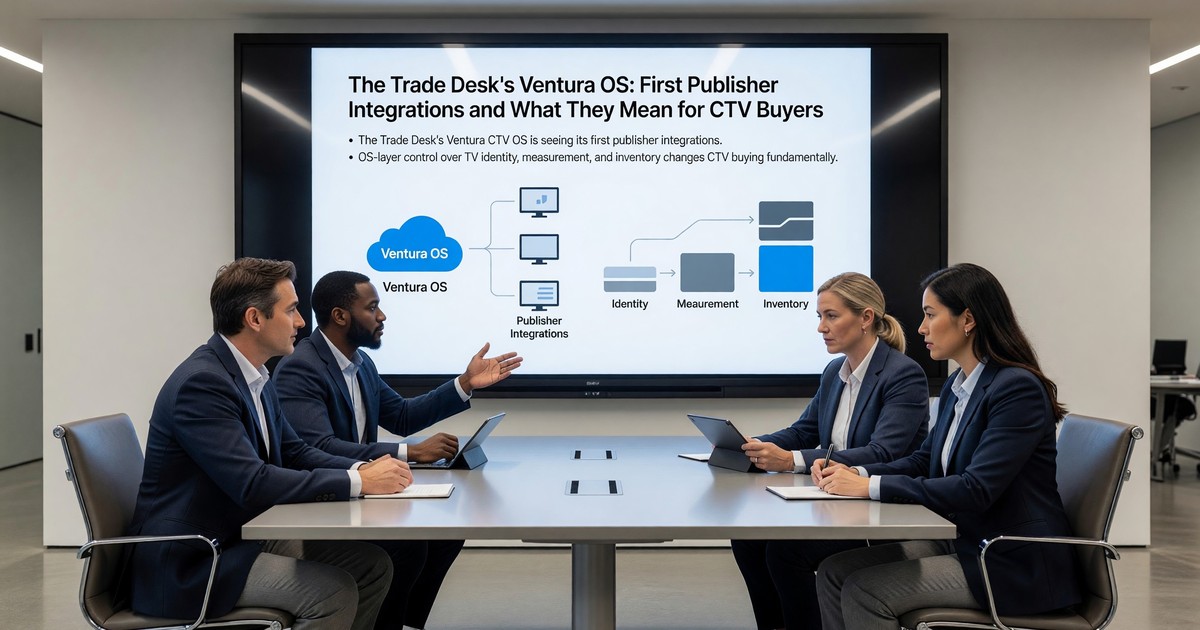
The Trade Desk’s Ventura operating system for connected televisions has moved from announcement to live integrations. The company revealed its first publisher and device partner relationships for Ventura in recent weeks, and the picture of what the OS strategy actually enables — and what it threatens — is coming into sharper focus.
Ventura is not just a new CTV ad product. It’s The Trade Desk’s attempt to own the layer of the television stack that controls identity, user interface, content discovery, and advertising access simultaneously. Understanding why that layer matters, and what first publisher integrations tell us about the strategy’s viability, is essential context for CTV buyers planning their 2026 upfront negotiations and annual media plans.
Why the OS Layer Is the Strategic Prize in CTV
The CTV advertising market has a fundamental structural problem that Ventura is designed to solve: fragmented identity across devices and platforms creates targeting and measurement inefficiency that significantly limits what CTV advertising can actually deliver.
On a Roku device, the user’s identity is Roku’s to control. On Amazon Fire TV, it’s Amazon’s. On Samsung Smart TV, Samsung’s. Each walled garden manages its own identity graph, its own audience segments, its own measurement methodology, and its own advertising marketplace. Buyers who want to reach a specific audience — a CRM list, a high-value shopper segment, a competitive conquesting target — must work within each walled garden’s rules, often paying walled garden CPMs and accepting walled garden attribution.
The OS layer is where these decisions are made. The operating system controls what app is displayed by default, how content is organized in the user interface, what identity signals are shared with which advertising partners, and crucially — how advertising inventory is structured, priced, and accessed.
An OS that The Trade Desk controls would, for the first time, give a pure-play buy-side DSP direct influence over these decisions. Rather than negotiating access to each walled garden’s inventory and identity data, The Trade Desk’s buyers would be transacting through an OS that’s designed to maximize buy-side transparency and targeting fidelity.
The First Publisher Integrations
The Trade Desk’s early Ventura partner announcements include streaming content providers and device manufacturers who are interested in an OS alternative to the existing major platforms. The specific commercial logic for these partners: Ventura’s publisher terms offer a revenue share structure and data ownership arrangement that is more favorable to publishers than the deals available from Roku, Amazon, or Google TV.
Roku takes a substantial revenue share on advertising that runs through its platform, including a cut of programmatic CPMs transacted by third-party buyers using Roku’s OneView DSP infrastructure. Amazon’s Fire TV operates similarly — inventory that runs through the Fire TV interface generates revenue sharing with Amazon. Publishers who develop apps on these platforms are giving a portion of their advertising revenue to the platform operator in exchange for distribution.
Ventura’s positioning is to offer publishers more favorable economics in exchange for distributing content through the Ventura-powered device interface. The Trade Desk’s business model is DSP fees from buyers — not supply-side revenue sharing — which theoretically allows it to offer publishers better economics than platforms that are monetizing both sides of the marketplace.
The Trade Desk’s published Ventura documentation describes the architecture as built around OpenID Connect and standardized identity infrastructure, allowing authenticated user identities — email-based or phone-based — to flow through the OS to advertising partners without the opacity that characterizes walled garden identity management.
What Ventura Means for Authenticated Audiences in CTV
The identity architecture of Ventura is its most commercially significant feature for programmatic buyers. Currently, the only way to reach a specific audience on CTV with high fidelity is to work within a walled garden’s matching infrastructure — uploading a customer list to Amazon DSP or Roku OneView and trusting that their matching methodology accurately identifies your customers on their platform.
Ventura proposes to handle identity at the OS level using UID2 or equivalent open-source identity resolution, with the user’s authenticated identifier flowing through advertising transactions in a way that’s accessible to DSP buyers who are using The Trade Desk. A brand running a campaign through The Trade Desk against a UID2-enabled CRM audience would, on a Ventura-powered TV, see that audience matched at the OS level rather than through a walled garden intermediary.
The implications for buyers: UID2-based CTV targeting that works across Ventura-powered devices without separate walled garden data partnerships, frequency capping that works across screens for authenticated users (not just within a single platform), and attribution measurement that connects CTV exposure to downstream purchase without requiring an Amazon-owned closed loop.
This is a significant improvement over the current CTV identity fragmentation — if it achieves scale. The critical question is whether Ventura-powered devices reach audiences that are meaningful for programmatic buyers, and that question depends entirely on device distribution.
The Roku, Amazon, and Samsung Question
Ventura’s strategic logic is compelling. Its execution challenge is formidable.
Roku has more than 80 million active accounts and is the most widely distributed streaming platform in North America. Amazon Fire TV has comparable penetration. Samsung Smart TV is the largest smart TV manufacturer by unit share. All three are deeply established in living rooms across the country, with incumbent content libraries, user interfaces that consumers are habituated to, and advertising businesses that generate substantial revenue.
For Ventura to reach meaningful buyer scale, it needs to be distributed on devices that consumers actually purchase in large numbers. The Trade Desk has announced relationships with device manufacturers interested in an OS alternative — but breaking Roku’s and Amazon’s distribution advantages requires either a hardware partner with significant retail presence (a major TV manufacturer like a Samsung, LG, or Hisense decision to adopt Ventura would be transformative) or a long-term consumer acquisition strategy that builds Ventura’s installed base incrementally.
The scenario most favorable to Ventura: a major TV manufacturer partnership that ships Ventura as the default OS on a meaningful share of new TV units in 2026-2027, combined with compelling content aggregation that gives consumers a reason to prefer the Ventura interface. This is achievable but not guaranteed.
What CTV Buyers Should Do Now
Ventura’s first integrations are a signal to start building operational familiarity, not a reason to shift budgets immediately. The practical actions for CTV buyers:
Request Ventura beta access through The Trade Desk. Understanding how Ventura-powered inventory appears in TTD’s platform, what targeting signals are available, and what measurement outputs look like for early integrations is valuable pre-scale intelligence. Buyers who learn the product early are better positioned when scale arrives.
Audit your UID2 CTV activation. Ventura’s identity architecture is built on UID2. Buyers who have not implemented UID2 across their CRM and identity resolution workflows will be less equipped to capture Ventura’s authenticated targeting advantage. UID2 readiness is a prerequisite for Ventura’s most differentiated features.
Maintain walled garden diversification. Ventura doesn’t replace existing CTV buying — it adds an option. Continue running on Roku, Amazon, and FAST channel networks while building Ventura testing into Q3-Q4 media plans. The measurement comparison across platforms will provide the most useful scaling signal — and as we’ve examined in our analysis of CTV ad fraud and the supply chain quality gap, shorter and more transparent supply paths are also the most effective structural defense against the invalid traffic concentrating in opaque CTV reselling chains.
FAQ
Q: Does Ventura compete with Roku and Amazon’s ad marketplaces, or is it complementary? Ventura is a direct competitor to Roku OneView and Amazon Fire TV’s advertising infrastructure at the OS level. If Ventura achieves significant device distribution, it competes for the advertising dollars that currently flow through Roku and Amazon’s CTV ad platforms. The Trade Desk’s positioning is buyer-friendly differentiation — lower take rates, better identity transparency, open measurement — which is a competitive challenge to Roku’s and Amazon’s walled garden model.
Q: Can publishers distribute content on both Roku/Amazon and Ventura simultaneously? Yes. Publishers distribute apps across platforms independently. A streaming service can have apps on Roku, Fire TV, Samsung, and Ventura-powered devices simultaneously. The difference is what advertising infrastructure and revenue share each platform imposes. Ventura’s appeal to publishers is more favorable economics, not exclusivity.
Q: What identity signal does Ventura use — UID2, RampID, or a proprietary identifier? Ventura is built around UID2 as the primary identity framework, with the OS-level identifier flowing through advertising transactions via OpenID Connect-based authentication. This is consistent with The Trade Desk’s broader UID2 investment and means buyers using TTD with existing UID2 integrations should find Ventura’s identity infrastructure familiar.
Q: How does Ventura handle users who are not authenticated (not signed into a streaming account)? Unauthenticated users on Ventura-powered devices are served contextual and interest-based advertising using Topics API-style signals rather than identity-matched targeting. The full Ventura identity advantage requires user sign-in, which is a standard requirement for accessing premium streaming content and is typically achieved through content app authentication rather than requiring a separate Ventura account.
Further Reading from Authoritative Sources
- IAB Tech Lab UID2 standard for CTV identity and cross-device targeting — The IAB Tech Lab hosts the UID2 open standard that Ventura is explicitly built around, making it the authoritative technical reference for understanding how Ventura’s OS-level identity architecture works and how buyers should implement UID2 to capture Ventura’s authenticated CTV targeting capabilities.
- IAB programmatic CTV advertising standards and marketplace dynamics — The IAB’s CTV advertising standards and market analysis provide the authoritative framework for understanding the identity fragmentation and walled garden dynamics that Ventura is designed to address.