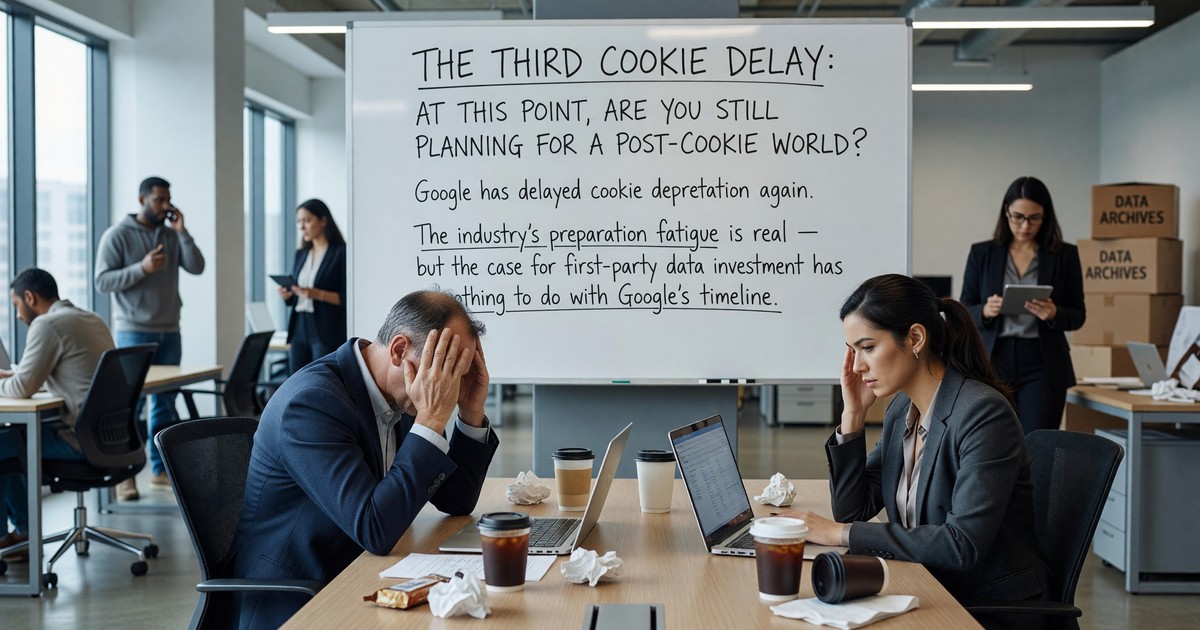
Google has delayed third-party cookie deprecation in Chrome to the second half of 2024. The original deadline was 2022. The first extension moved it to late 2023. Now it is H2 2024. If you have been in programmatic for more than a few years, you have now received three different cookie deprecation deadlines, each with enough lead time to theoretically drive fundamental infrastructure change, and none of which has produced the industry transformation that was supposed to happen.
The preparation fatigue is real and it deserves to be named. Teams have written post-cookie strategy documents. Identity vendors have been evaluated. First-party data roadmaps have been drafted, re-drafted, presented to leadership, approved in principle, and then deprioritized when the cookie was still there the next quarter. Clean room conversations have been had. Privacy Sandbox tests have been run with results that were inconclusive enough to justify deferring commitment. And now there is another extension.
The extension is not a reprieve. It is a trap.
Why Google Delayed Again
Google’s stated reasons for the extension focus on the need for additional Privacy Sandbox API testing time and the desire to avoid disrupting the advertising ecosystem. The official Chrome developer blog post frames it as responsible stewardship: the Privacy Sandbox APIs need more maturation before they can reliably support the advertising use cases that third-party cookies currently serve.
That explanation is accurate as far as it goes. The Privacy Sandbox API performance in testing has been mixed — Topics API reach limitations are well-documented, Attribution Reporting API has significant measurement fidelity gaps versus cookies, and the FLEDGE proposal for interest-group-based advertising has had challenging latency characteristics in early tests. The infrastructure genuinely is not ready.
What the official explanation doesn’t address is the competitive and regulatory context. The UK’s Competition and Markets Authority has an active monitoring agreement with Google over Privacy Sandbox development, specifically designed to ensure Google does not use cookie deprecation to advantage its own ad products. The CMA’s involvement has added procedural requirements to Privacy Sandbox deployment timelines. There is also ongoing regulatory scrutiny in the EU and several US states. The delay is technically motivated and also regulatory-process motivated, and both are real.
For advertisers, the motivation behind the delay matters less than the consequence: third-party cookies will continue to function in Chrome beyond 2023, which means the short-term performance cost of transitioning off cookie-dependent targeting is deferred. This deferral is precisely where preparation fatigue turns dangerous.
The Preparation Fatigue Problem
Here is how preparation fatigue unfolds at a specific advertiser. In 2020, the team commits to building first-party data infrastructure. CRM integration with the DSP is prioritized. A clean room evaluation is initiated. Budget is allocated. Then cookie deprecation moves to 2023. The urgency cools slightly — there is time. Other projects compete for engineering resources. The clean room evaluation stalls in vendor selection. The CRM-DSP integration works well enough for remarketing but the full identity resolution project is not complete.
In 2022, the cookie deprecation moves to 2024. The response: relief that current campaigns don’t need to change. The first-party data project is on the roadmap but not the sprint. The clean room is still in evaluation. And the net result, after two years of “working on post-cookie readiness,” is a team that is marginally more sophisticated about identity resolution than it was in 2020 but still fundamentally dependent on third-party cookies for performance optimization.
The deadline extension did not cause this. Preparation fatigue caused this, and the deadline extension gave it permission to continue. The distinction matters because the solution is not to wait for a deadline that forces change — it is to build infrastructure that creates competitive advantage whether or not the deadline ever arrives.
First-Party Data Investment Is Not About Cookies
The cleanest reframe for post-cookie preparation work is to remove cookie deprecation from the value equation entirely. First-party data infrastructure — authenticated users, email capture, CRM integration, server-to-server event tracking — is valuable in a cookie world, in a cookieless world, and in whatever partial-signal environment materializes between those states.
In a cookie world: first-party data lets you build owned audiences that perform better than third-party segments because they are based on actual customer behavior. Look-alike models seeded from CRM data consistently outperform generic third-party audience segments in conversion rate and ROAS. This is measurable today, with cookies fully operational.
In a cookieless world: first-party data is the primary targeting signal that survives. Email-based identity resolution through platforms like LiveRamp’s RampID or The Trade Desk’s Unified ID 2.0 enables targeting continuity across the open web. Publisher authentication programs — requiring email login to access content — create deterministic identity linkage that doesn’t rely on browser storage at all.
In a partial-signal world — which is where we actually are, given Firefox’s long-standing cookie restrictions, Safari’s ITP, and iOS ATT’s impact on mobile: first-party data investment already has measurable ROI in environments where third-party cookies don’t work. Firefox and Safari account for a meaningful proportion of web traffic. The performance gap between cookie-based and cookieless targeting is not a future problem. It is a current one, already affecting campaign performance on a significant portion of impressions.
What “Cookie Indifference” Means in Practice
The goal is not to survive cookie deprecation. It is to build a data and measurement infrastructure that performs well regardless of the cookie status in any given browser or environment. This is cookie indifference, and it is a higher standard than cookie deprecation preparation.
Cookie indifference requires three things. First, a robust first-party identity layer: email-based authentication where possible, clean CRM data matched to advertising identifiers, and server-side event tracking that routes conversion signals through your own infrastructure rather than browser pixels. Second, a measurement architecture that works across ID environments: media mix modeling for cross-channel attribution, incrementality testing as a complement to platform-attributed ROAS, and clean room capabilities for privacy-safe audience analysis. Third, a supply path strategy that weights authenticated inventory — publisher login programs, walled gardens with consented first-party data — appropriately relative to anonymous open-web inventory.
IAB Tech Lab’s Project Rearc and its successor work provide a useful framework for evaluating specific technical components of cookie-independent identity resolution. The work is ongoing and vendor-specific implementations vary, but the conceptual architecture is clear: consent-based, authenticated, interoperable identity that doesn’t require browser storage.
The delay to H2 2024 means the specific performance hit from cookie deprecation in Chrome is not arriving this year. It does not mean the work of building cookie-indifferent infrastructure should wait.
FAQ
Why does Google keep delaying cookie deprecation? Google has cited the need for additional Privacy Sandbox API testing time and the desire to ensure the advertising ecosystem has adequate alternative infrastructure before cookies are removed. Regulatory oversight from the UK’s Competition and Markets Authority has also introduced procedural requirements that affect the timeline.
Is Safari already cookieless for advertising purposes? Safari’s Intelligent Tracking Prevention has effectively blocked third-party cookies since 2019, and Firefox has blocked them since 2022. Chrome represents the largest remaining share of desktop browser traffic that still allows third-party cookies, which is why its deprecation timeline has received disproportionate attention.
What is Unified ID 2.0 and how does it differ from cookies? Unified ID 2.0, developed by The Trade Desk, is an email-based identifier that uses hashed, encrypted email addresses as the basis for pseudonymous user identification across the open web. It requires user opt-in and publisher cooperation to generate IDs, and is designed to work without browser storage. UID 2.0 is cookieless but also requires significantly more publisher infrastructure than passive cookie-based tracking.
Should advertisers still be investing in Privacy Sandbox API testing given the delay? Yes, but the priority should be understanding Privacy Sandbox performance characteristics relative to cookies, not replacing cookies with Privacy Sandbox APIs immediately. Running controlled tests that benchmark Topics API reach and FLEDGE optimization against cookie-based baselines provides the measurement data needed to understand the actual performance gap when deprecation eventually arrives.