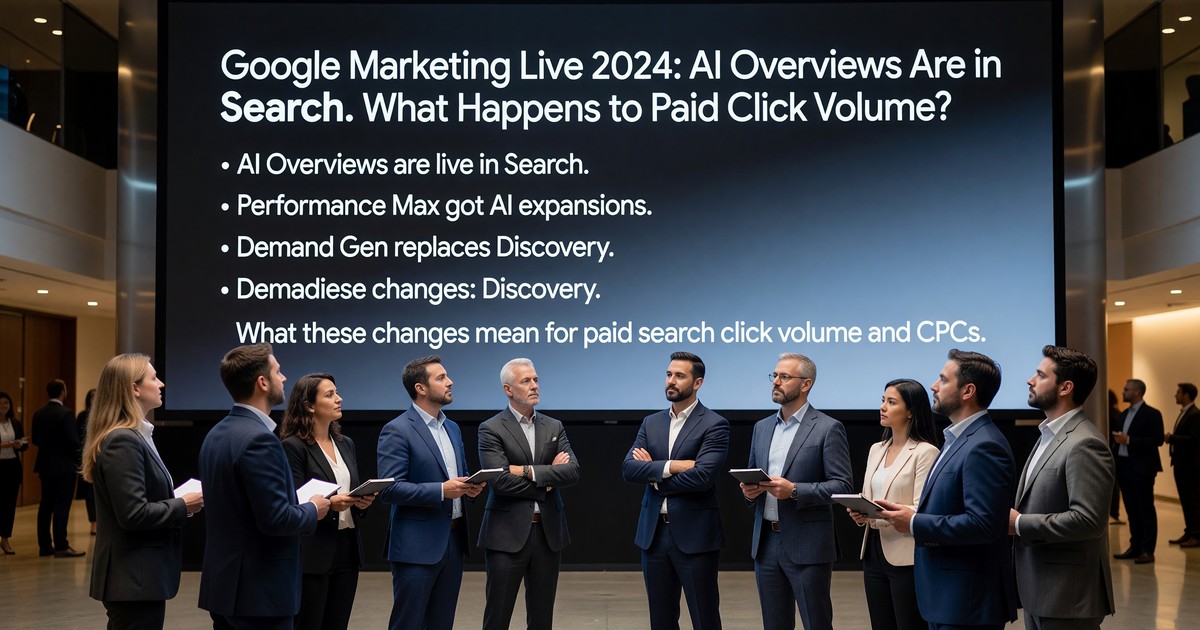
Google Marketing Live 2024 arrived with the AI integration in Search already live. AI Overviews — the product previously known as Search Generative Experience during its 14-month testing period — rolled out to US users in the days before GML, making this week’s announcements the first product showcase for an AI-modified search experience that’s already serving commercial queries.
The advertising implications are not theoretical. They’re happening to running campaigns right now.
AI Overviews: The Organic-Paid Boundary Is Shifting
AI Overviews appear at the top of Search results pages for a significant share of informational and consideration-stage queries. When present, the AI-generated summary occupies substantial visual space above the organic results — and, increasingly, above the paid search ads.
Google has maintained that ads appear below AI Overviews in labeled “sponsored” positions, consistent with prior ad placements. What the company hasn’t resolved clearly is what happens to click-through rates on paid ads when an AI-generated answer sits between the search intent and the advertiser’s message.
Early data from search marketers running campaigns against informational queries is showing what intuition would predict: queries where AI Overviews provide a complete answer — a definition, a how-to, a comparison summary — are seeing CTR pressure on both organic and paid results below the overview. Queries where the overview creates a consideration frame without resolving the commercial intent — “best parking management software for hospitals,” “compare access control systems” — appear to drive users to click through at rates comparable to pre-AI Overviews baselines.
The distinction matters enormously for campaign strategy. Google’s own research has emphasized that AI Overviews increase search engagement and satisfaction. What it doesn’t resolve is whether that engagement translates to commercial click volume — or whether the answer-in-place-of-click dynamic seen in featured snippets scales up dramatically with AI-generated summaries.
Performance Max: AI Gets More Autonomy
Google’s Performance Max announcements at GML 2024 centered on expanded AI creative generation and asset optimization. The platform now generates more ad creative variants, including image assets, from advertiser-provided brand inputs, and the targeting decisions across Search, Display, YouTube, Discover, Gmail, and Maps happen through AI optimization with less human-configurable control than prior campaign types.
The criticism of PMax from buy-side operators has been consistent for two years: insufficient transparency into where spend is going and why. Google’s response at GML was to announce additional reporting features — asset group performance breakdowns, channel-level spend visibility — rather than restoring the controls that pMax replaced.
The new PMax features worth tracking are the campaign-level negative keyword implementation (finally) and the ability to upload brand guidelines that inform AI creative generation. Both are meaningful improvements. The fundamental tension — a campaign architecture that prioritizes Google’s AI optimization over advertiser control — is unchanged.
For advertisers running Performance Max alongside traditional Search campaigns, the cannibalization question remains active. Internal Google search term data for PMax campaigns is still less granular than for standard Search, which means attributing sales impact and managing query coverage between campaign types requires workarounds that most smaller advertisers and agencies aren’t equipped to execute rigorously.
Demand Gen Replaces Discovery: What Changes
Discovery campaigns are transitioning to Demand Gen, with full migration in the second half of 2024. Demand Gen expands the inventory base — adding YouTube Shorts placements and more image inventory — and integrates AI-driven audience modeling that the Discovery product didn’t have.
The positioning is explicitly upper-funnel: Demand Gen is Google’s answer to Meta’s Advantage+ Shopping campaigns for prospecting. The audience signals Demand Gen uses include interest data, YouTube watch history, search query patterns, and lookalike modeling from customer lists — a reasonably powerful foundation for finding new customers at scale.
What the Demand Gen transition removes, however, is one of Discovery’s key advantages for direct response advertisers: the ability to use precisely defined audience targeting to reach high-intent users in Discover and Gmail feed environments. Demand Gen shifts control toward AI audience expansion, which performs better on average but worse for specialized targeting scenarios.
Advertisers who ran Discovery primarily for its lower-funnel retargeting use case will find Demand Gen to be a different product than they had. The swap will require measurement recalibration and budget reallocation testing before the right optimization parameters become clear.
The CPM and CPC Implications of AI-First Search
Beyond the product announcements, GML 2024 is significant for what it signals about Google’s auction dynamics going forward. AI Overviews serve as a natural content layer that may absorb some commercial intent before it reaches the paid auction. If click volume on commercial queries does compress — and the evidence is currently mixed — Google would compensate by increasing ad load, raising quality score requirements, or (more likely) expanding ad placements in ways that aren’t immediately visible to advertisers.
The practical concern for search buyers is that CPCs for surviving, high-intent clicks may rise as advertisers concentrate spend on the queries that AI Overviews leave commercially unresolved. If 20% of informational queries get fully answered by AI Overviews without a click, the 80% of commercial queries where clicks still happen become more contested. Supply contracts while demand stays constant — which is an auction dynamic that favors Google’s revenue even as total click volume potentially falls.
Search Engine Land’s ongoing AI Overviews tracker is documenting which query types are receiving AI Overview treatment. Advertisers should be cross-referencing their campaign keyword lists against this data to understand which query segments face the most AI summary exposure and planning CPCs accordingly.
What GML 2024 Means for Agency Strategy
The structural theme running through every GML 2024 announcement is the same: Google is moving ad products toward AI optimization and away from human-configured precision targeting. Every product transition announced — PMax expansion, Demand Gen migration, AI creative generation, broad match AI improvements — represents a reduction in the menu of controls available to practitioners.
For agencies, this creates a difficult conversation with clients. The expertise that differentiated skilled search buyers — sophisticated audience targeting, granular match type management, conversion funnel bidding structures — is being systematically replaced by automation. What agencies can offer instead is business input quality (better first-party data, better conversion measurement, better goal configuration), strategic creativity (positioning, offer, creative development), and channel allocation judgment that Google’s own tools can’t execute.
The agencies that will fare best are those that have already transitioned their value proposition from configuration expertise to business strategy. The ones that haven’t are facing a product roadmap that treats their competitive advantage as a legacy feature.
FAQ
Q: Will AI Overviews show paid search ads within the AI-generated summaries themselves? Google has tested “AI Overview ads” — sponsored product listings that appear within or immediately below AI-generated summaries for commercial queries. This functionality is in testing as of GML. The format is still being refined, and ad placement within AI Overviews for Shopping and Service queries is the most likely near-term expansion.
Q: Should advertisers pause Search campaigns on informational keywords now that AI Overviews are live? Not necessarily. The click-intent relationship depends heavily on query type. Informational queries where AI fully resolves the answer may warrant budget reallocation, but commercial consideration queries (comparisons, vendor evaluations, product searches) continue to generate click intent. Monitoring CTR by query segment over the next 60 days will provide cleaner guidance than making changes preemptively.
Q: What is the recommended approach for managing Performance Max and standard Search campaign overlap? Set brand-level and high-performing exact match terms as campaign-level negatives in PMax (now available) to prevent cannibalization of known-performer keywords. Use standard Search campaigns for exact and phrase match control on conversion-critical terms, and let PMax handle discovery and expansion on incremental queries. Monitor the ratio of branded vs. non-branded search term coverage in PMax impression reports.
Q: How does Demand Gen compare to Meta’s Advantage+ Shopping for top-of-funnel performance? Meta Advantage+ Shopping remains stronger for most direct-to-consumer e-commerce advertisers because of the depth and accuracy of Meta’s social interest graph and its superior lookalike modeling for consumer audiences. Demand Gen has advantages for B2B and intent-based prospecting where YouTube watch history and Search query signals are more predictive. Most advertisers with sufficient budget should test both and measure incrementally rather than defaulting to one platform.