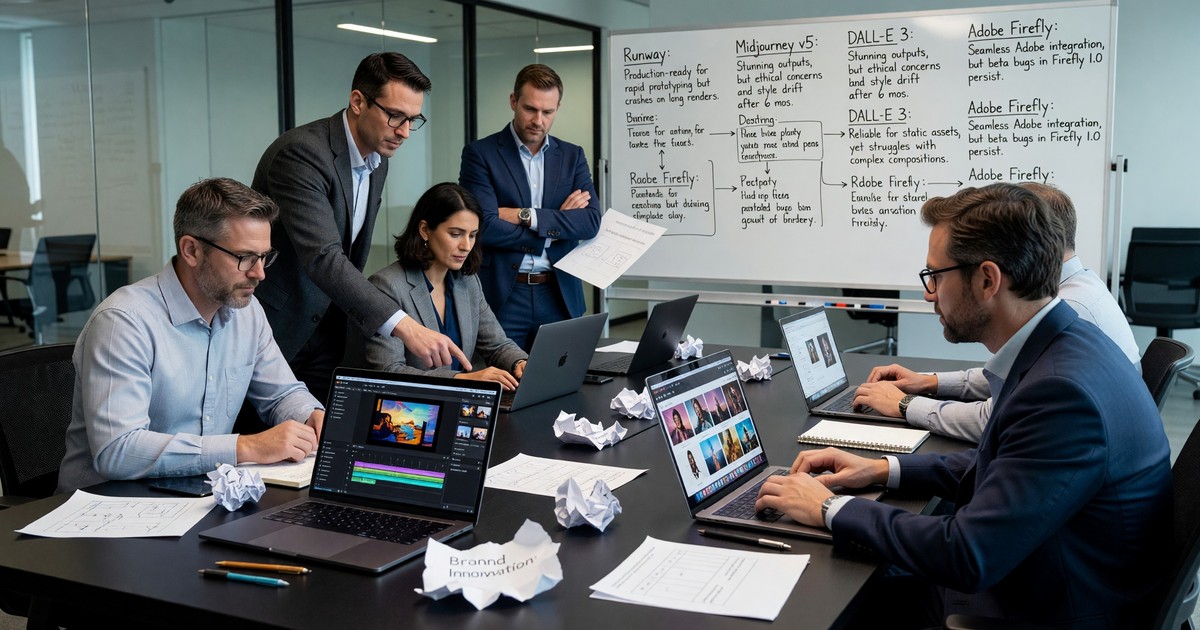
Six months of real production use is enough time to separate the genuine capability from the demo-optimized performance. The generative AI tools that launched or significantly updated in the first half of 2023 — Midjourney v5, DALL-E 3 via ChatGPT and API, Runway Gen-2 for video generation, and Adobe Firefly’s commercial launch — have been in actual agency creative workflows long enough for practitioners to have honest opinions about what works and what still fails in ways that matter for production advertising creative.
The pattern that emerges from conversations with agency creative technology teams across holding company and independent shops is consistent: static image generation is production-ready for specific use cases, video generation is directionally impressive but not production-ready for most commercial applications, text generation for ad copy has clear workflow fits and clear failure modes, and the IP clearance question remains the most practically important unresolved issue for commercial advertising use.
Static Image Generation: Where It Has Earned Its Place
Midjourney v5 and DALL-E 3 represent a meaningful step change from v4 and the earlier DALL-E models — the improvement in image coherence, prompt adherence, and compositional quality is significant enough that creative professionals who dismissed earlier versions as toy-grade have revisited their assessments.
The use cases where static generation is earning consistent production use in agency workflows:
Concept visualization and mood boarding at the pitch stage. Creating visual representations of campaign concepts before any production budget is committed is where generative tools have the clearest ROI. A campaign concept can be visually communicated in hours rather than days of art direction and stock sourcing. The quality threshold for pitch-stage visualization is lower than production creative, which means the current tools clear the bar reliably.
Background and environment generation for product photography. The specific workflow: photograph the product in a neutral studio setup, then use generative tools to place the product in lifestyle environments. Adobe Firefly’s object placement and background generation, trained on licensed Adobe Stock imagery, handles this workflow with enough quality consistency for mid-tier production requirements. The IP clearance advantage of Firefly — Adobe’s commercial use licensing terms cover generated outputs from its licensed training data — makes it the default choice for clients with legal review requirements.
Variant generation for A/B testing. Generating color, crop, and composition variants of a hero image for display ad testing requires the kind of structured variation that generative tools handle well. Producing 15 background color variants of a product ad for multivariate testing is genuinely faster and cheaper with generation than with retouching workflows.
Where Image Generation Still Fails Commercially
The failure modes are predictable but still commercially significant. Human hands remain a consistent problem area — the tendency toward incorrect anatomy, extra fingers, and implausible hand positions is well-documented and has not been fully resolved in any current production model. Advertising creative frequently features hands prominently (holding products, gesturing, demonstrating use). Any creative concept that requires realistic hand representation needs human direction and retouching even when AI generation handles the rest of the image.
Text rendering within images is improving but still unreliable in commercial contexts. Generating an image that incorporates legible, correctly spelled brand text or product copy in a specific typeface is not consistently achievable with current models. Advertising that includes text overlays on imagery (which is most advertising) requires text to be added and styled separately rather than generated within the image.
Brand consistency over a campaign run is a structural limitation that will not be solved by better models alone. Each generated image is independently produced — there is no persistent visual memory that ensures the brand’s hero character looks the same across 50 generated images, or that the product is depicted with consistent lighting and dimensions. Maintaining brand visual consistency across a generated campaign requires extensive prompt engineering, reference image injection, and post-generation quality review.
Video Generation: The Directional Promise and the Production Gap
Runway Gen-2, Pika Labs, and the video capabilities in Adobe Firefly represent a genuinely new creative tool category. Short-form video generation — 3-5 second clips from text or image prompts — is usable for social media content and lower-production contexts.
The production gap for commercial television or digital video advertising is currently significant. Issues include: temporal consistency (objects change appearance between frames, backgrounds shift inconsistently), motion quality (movements look uncanny in ways that are immediately visible to trained eyes), and resolution limitations that do not meet broadcast standards. These are engineering problems that are being actively worked on; the models will improve. In November 2023, video generation is a research and exploration tool for most advertising applications, not a production substitute for filmed content.
Runway’s Gen-2 model and its successors are producing output that is genuinely useful for social-native content formats — Reels, TikTok, motion graphics — where the aesthetic conventions are more flexible and the production quality bar is lower than broadcast television. Agencies building production workflows for always-on social content are finding more utility here than those evaluating tools for major campaign TV production.
Adobe Firefly’s Commercial Launch: Why Licensing Matters
Adobe Firefly’s commercial launch in September 2023 is the most practically important development for advertising agencies operating under IP clearance requirements. Firefly is trained exclusively on Adobe Stock images and public domain content, and Adobe’s terms of service provide commercial use indemnification for generated outputs.
This is not a minor distinction. The legal uncertainty around AI image generation — whether generated outputs can infringe on the training data’s copyrights — remains legally unresolved. Several class action lawsuits against Stability AI, Midjourney, and DeviantArt are working through the US court system. For clients in categories where IP clearance is a standard legal requirement — regulated industries, large brand advertisers, publicly traded companies with IP exposure — using tools without commercial use indemnification carries real legal risk.
Firefly’s image quality has caught up to be competitive with Midjourney v5 for the use cases most relevant to advertising (product-in-lifestyle staging, clean commercial imagery, text-adjacent graphics). The creative community’s consensus is that Midjourney v5 produces more visually striking imagery for unconstrained creative work; Firefly produces more commercially safe, predictable imagery that is appropriate for regulated advertising contexts.
The Role Human Creative Professionals Now Play
The most useful practical frame for how agency producers are adapting to these tools: AI generation has shifted the value in creative production from repetitive execution to creative direction and quality control. The hours that previously went into executing a competent but unremarkable concept now go into directing the AI system to produce something better, identifying where the AI fails, and editing toward brand-appropriate quality.
This does not describe a smaller role for creative professionals. It describes a different role — one that requires higher-level creative judgment and technical fluency with generation tools simultaneously. The practitioners who are thriving in this environment are those who have developed prompt engineering skills alongside their existing creative direction capabilities. Those who have resisted engagement with AI tools are finding themselves increasingly disadvantaged in production speed and cost competitiveness.
FAQ
Which AI image generation tools are considered production-ready for commercial advertising in late 2023? Adobe Firefly is the preferred choice for clients with IP clearance requirements due to its licensed training data and commercial use indemnification. Midjourney v5 and DALL-E 3 produce high-quality imagery but do not offer commercial use indemnification, which is a legal risk factor for major advertisers. For concept visualization, pitch materials, and content that does not carry IP clearance requirements, all three are production-quality.
Is AI video generation ready for use in broadcast TV commercials? Not in late 2023. Current video generation tools (Runway Gen-2, Pika Labs) produce output suitable for social media content and internal presentations, but temporal consistency, motion quality, and resolution limitations make them unsuitable for broadcast-standard commercial production. The technology is advancing rapidly and this assessment will likely change in 2024.
How do agencies handle the IP indemnification question for AI-generated creative? Agencies using AI tools for commercial advertising client work should: use platforms with explicit commercial use licensing (Adobe Firefly), include AI generation tool usage in IP representations made to clients, obtain client sign-off on AI generation use in contracts or project agreements, and maintain records of which tools were used for which assets. Clients with in-house IP clearance requirements may impose restrictions on which tools agencies can use.
Does using AI image generation reduce agency creative fees? The direct production cost for certain tasks decreases when AI generation substitutes for manual photography, illustration, or retouching. However, the total work involved in creative concepting, AI direction, quality review, and brand-appropriate editing means that the time savings are in execution rather than the creative process overall. Many agencies are passing some cost reduction to clients while reinvesting time in higher-value creative strategy and direction work.