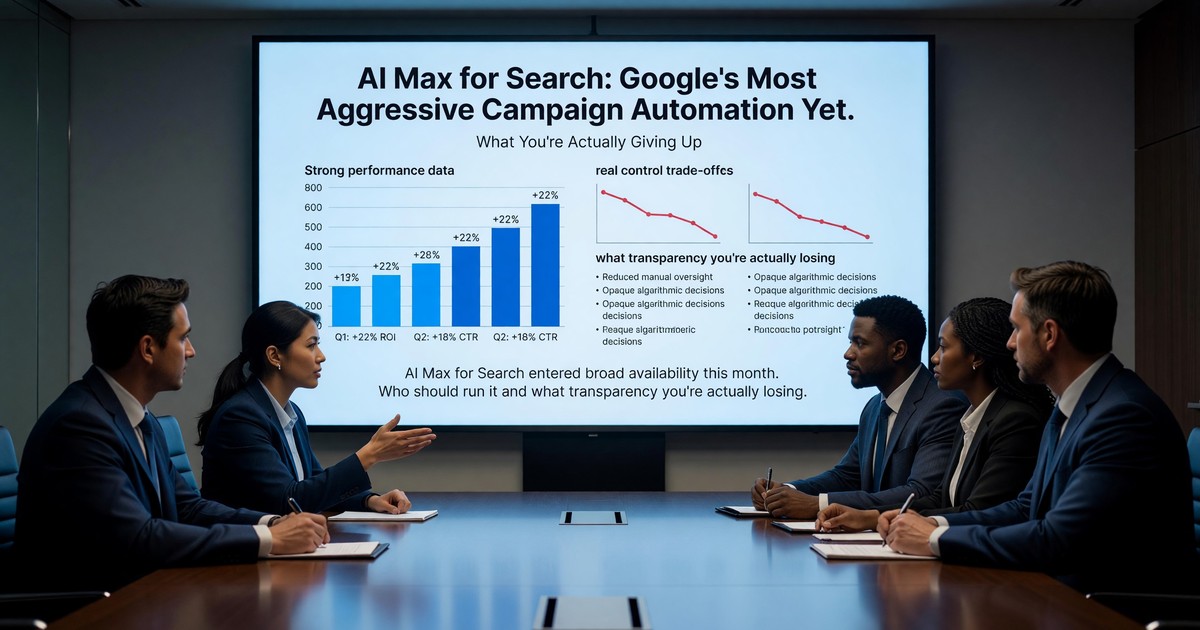
AI Max for Search has entered broad availability. Google began rolling out the feature to advertisers globally in March 2026, after a limited beta period that generated enough performance data to build the product case internally. The company is now actively encouraging adoption, and the pitch is hard to ignore: AI Max for Search consistently outperforms equivalent manually configured search campaigns in conversion volume at comparable or lower cost per conversion.
The performance case is real. The control trade-offs are also real. Understanding both clearly is necessary before making an adoption decision — because AI Max for Search is Google’s most aggressive campaign automation product to date, and the things it does automatically have direct implications for campaign transparency, budget control, and competitive strategy.
What AI Max for Search Actually Does
AI Max for Search expands search campaign behavior in two specific directions: keyword matching and landing page selection. Both expansions happen through AI decision-making with limited explicit control.
Expanded Keyword Matching: AI Max enables Google’s AI to serve your ads on search queries that extend significantly beyond your specified keyword list. The expansion uses your existing keywords as signals, combined with your ad copy, landing pages, and historical conversion data, to identify queries that Google’s AI judges to be conversion-likely — even if those queries wouldn’t be matched by broad match under standard campaign configuration.
The difference from standard broad match: AI Max’s matching scope is wider and based on downstream conversion probability modeling rather than semantic similarity. A campaign for “enterprise parking management software” might serve on queries like “parking operator technology ROI,” “automated parking fee collection,” or “commercial lot management systems” — queries that broad match would recognize as related but that AI Max’s conversion modeling may identify as disproportionately valuable.
Dynamic Landing Page Selection: AI Max can override your designated landing page and serve a different page from your site that its AI judges to be more relevant to the specific query. If a user searches for “hospital parking management” and your site has a hospitals vertical page, AI Max may route that user to the vertical page rather than your specified ad group landing page.
The capability is powerful in theory. In practice, it creates visibility problems: you no longer control which landing page experiences users are receiving for which queries, and the mapping of query to experience is determined by Google’s model, not your conversion funnel strategy.
The Transparency You’re Giving Up
The transparency concerns with AI Max for Search are not hypothetical — they’re specific, documented, and worth understanding before enabling the feature.
Search term visibility: Standard search campaigns provide complete search term reports — every query that triggered an impression. Broad match campaigns have had some redaction of low-volume terms for privacy reasons. AI Max’s expanded matching generates query coverage that is partially opaque — some of the queries the AI is serving on are not visible in search term reports because they represent query types that Google’s privacy threshold prevents from appearing in reports. You cannot audit what you cannot see.
Ad group structure integrity: AI Max’s matching expansion crosses ad group thematic boundaries in ways that your campaign structure didn’t intend. A campaign organized around specific intent signals — branded vs. non-branded, product category vs. competitor terms, awareness vs. consideration stage — may see AI Max routing queries across these intent categories based on conversion probability signals that don’t respect your funnel stage segmentation.
Landing page control: Your landing page designations reflect decisions about user experience, conversion path, and message consistency that AI Max’s override capability doesn’t account for. If AI Max routes branded query traffic to a product category page because it has higher conversion rates historically, it may suppress brand experience quality in ways that are invisible in short-term conversion metrics.
Budget allocation opacity: AI Max doesn’t provide transparency into how incremental budget is being allocated to the expanded query types versus your core keyword coverage. Understanding whether your budget increase after enabling AI Max is generating incremental conversion from new queries, or simply spending more on the same queries at higher frequency, requires holdout testing that Google’s tools don’t facilitate directly.
The Performance Case: What the Data Actually Shows
The beta period results that Google has shared publicly — and the independent testing from large search management platforms — show consistently that AI Max for Search increases conversion volume. The mechanisms are plausible: better query coverage in long-tail conversion-likely search, landing page relevance improvements for specific query types, and AI bid optimization informed by conversion probability signals that manual bidding can’t access.
The magnitude of the improvement varies by account. Accounts with rich conversion data, diverse landing page assets that cover different audience segments, and campaigns already running on broad match see the largest gains. Accounts with limited conversion volume, single landing pages per ad group, or tightly branded conversion paths see more modest gains with more risk of query coverage dilution.
Google’s own AI Max documentation recommends a minimum of 30 conversions per campaign per month as a threshold for meaningful optimization. Below this threshold, the AI doesn’t have sufficient signal to model conversion probability accurately, and expanded matching is more likely to generate wasted spend.
Who Should and Shouldn’t Run AI Max
The adoption decision isn’t one-size-fits-all. A practical framework:
Run AI Max if you: have high conversion volume (50+ conversions/month per campaign), have diverse landing pages that cover multiple audience segments and query types, are currently revenue-constrained by query coverage gaps (you’ve exhausted keyword lists and want incremental reach), and have measurement infrastructure that allows you to validate incrementally generated conversions through holdout tests.
Don’t run AI Max if you: need precise query-level reporting for compliance or creative strategy reasons, have campaigns structured around deliberate intent-stage segmentation that AI Max’s cross-boundary matching would disrupt, have a single landing page or tightly controlled conversion path where landing page override would meaningfully degrade experience, or are operating in a category where competitive query interception is a strategic concern and you can’t audit it.
Test AI Max if you’re unsure: Enable AI Max on a single campaign with separate budget tracking, run for 60 days against a comparable control campaign, and measure incremental conversions through holdout methodology rather than relying on platform-attributed conversion volume comparison.
The Broader Trend AI Max Represents
AI Max for Search is the latest step in a direction Google’s search advertising product has been moving consistently for five years: reducing human-configured precision targeting in favor of AI-determined audience and placement decisions, in exchange for performance improvements that the AI delivers more consistently than manual configuration.
Performance Max, broad match AI improvements, automated assets, Demand Gen’s audience expansion — each product evolution trades explicit control for AI-optimized outcomes. AI Max for Search extends this pattern into the last remaining area of search where experienced buyers have maintained meaningful control: keyword match type management and landing page assignment.
The question practitioners need to answer honestly is not “does AI Max perform better” — it often does — but “what do I need to control, and why.” If the answer is “nothing beyond conversion volume,” AI Max is probably the right product. If the answer includes audit trails, intent-stage separation, competitive intelligence, or brand experience consistency, the control trade-offs matter in ways that conversion volume metrics don’t capture.
FAQ
Q: Can AI Max for Search and standard ad groups run in the same campaign, or must the entire campaign use AI Max? AI Max for Search is currently applied at the campaign level, not the ad group level. Enabling AI Max affects all ad groups within that campaign. Brands that want to test AI Max while maintaining control over specific keyword sets should create separate campaign structures — AI Max campaigns for expansion objectives and standard campaigns for controlled keyword coverage.
Q: Does AI Max affect Quality Score and historical campaign data? AI Max campaigns generate their own performance history. Enabling AI Max on an existing campaign changes its behavior forward but doesn’t delete historical data. Quality scores are reassessed based on the expanded query coverage, and initial performance after AI Max enablement may show variance as the AI calibrates to the new matching scope.
Q: How does AI Max interact with negative keywords? Negative keywords remain respected by AI Max — they are a hard exclusion that overrides AI expansion. This is the primary control mechanism available to buyers within AI Max campaigns. Comprehensive negative keyword lists are more important, not less, when running AI Max because the expanded matching scope increases the surface area for irrelevant query matching.
Q: Is AI Max for Search the same as Performance Max, or a different product? They are different products. Performance Max is a campaign type that runs across all Google inventory (Search, Display, YouTube, Gmail, Maps, Discover) with full AI optimization. AI Max for Search is a feature applied to standard Search campaigns that expands keyword matching and landing page selection within the Search network only. AI Max gives Search-only campaigns more automation without the full cross-channel coverage of PMax.
Further Reading from Authoritative Sources
- Google Ads official AI Max for Search documentation — Google’s official AI Max documentation is the primary authoritative source for the technical specifications and optimization requirements analyzed throughout this article.
- Marketing Week analysis of search campaign automation trends — Marketing Week provides authoritative trade analysis of search marketing automation trends and their implications for practitioners.