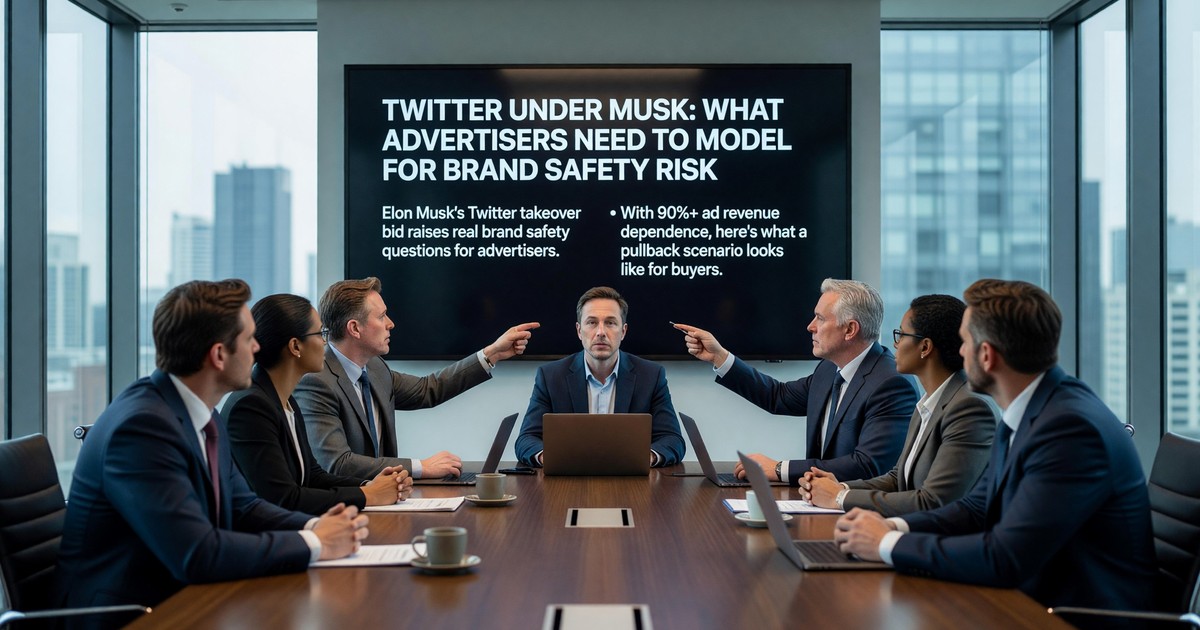
Elon Musk disclosed a 9.2% passive stake in Twitter on April 4, then escalated to an active acquisition offer at $54.20 per share on April 14. Twitter’s board initially adopted a poison pill defense. As of this writing, the outcome is unresolved, but the content moderation and brand safety implications for Twitter’s $4.5 billion advertising business are concrete enough to warrant immediate scenario planning.
Twitter is more advertising-dependent than most media buyers appreciate. Advertising accounted for approximately 90% of Twitter’s $5.08 billion in 2021 revenue. The platform has spent the past three years building out products and infrastructure — Brand Safety Controls, sensitive content filtering, the pre-bid exclusion segments in programmatic — specifically to address the brand safety concerns that have periodically triggered advertiser pullbacks. What happens to that infrastructure under an ownership change that has explicitly prioritized “free speech” as a primary value?
The Brand Safety Infrastructure Twitter Has Built
Twitter has made genuine progress on brand safety tooling since the advertiser concerns that surfaced during the 2020 brand safety crisis. The platform introduced adjacency controls that allow advertisers to exclude content categories — news and politics, sensitive topics, adult content — from their pre-roll video placements. It launched Twitter Amplify as a curated publisher program that pairs pre-roll ads exclusively with verified premium content partners, insulating those placements from organic timeline content.
Brand Safety Controls, launched in 2021, allow advertisers to apply keyword exclusions, topic exclusions, and content sensitivity filters at the campaign level. Twitter also integrated with third-party verification vendors — DoubleVerify and IAS — for post-bid monitoring and pre-bid avoidance on Amplify and timeline ad products. These are the same verification integrations that have become table stakes on YouTube and display inventory.
The concern for advertisers is not that this infrastructure disappears immediately under new ownership. The concern is that the content moderation policies that determine what content those safety tools need to protect against could shift significantly. If Twitter under Musk reduces content moderation staffing or changes enforcement thresholds for hate speech, coordinated inauthentic behavior, or political misinformation — all areas Musk has publicly indicated he views as over-moderated — then the content environment those brand safety tools are operating in changes materially.
What Musk Has Actually Said About Content Policy
Musk’s stated positions on Twitter content moderation are worth reviewing precisely because they are unusually specific for an activist investor in a media company. He has publicly described Twitter’s content moderation as a threat to free speech, called for a return of previously banned accounts including some deplatformed for policy violations, and framed his interest in Twitter partly as a response to what he characterizes as politically biased enforcement.
The Washington Post analysis of Musk’s stated policy positions published after the acquisition offer notes that many of Musk’s specific content policy criticisms have been directed at enforcement actions against accounts posting content that third-party brand safety vendors categorize as hate speech or violent extremism — precisely the categories that advertisers use adjacency controls to avoid.
This is not a political argument about whether Musk’s content positions are correct. It is a measurement argument: if the enforcement thresholds change, the distribution of content on the platform changes, and the proportion of organic Twitter content that triggers advertiser brand safety exclusions will change. Advertisers with tight brand safety parameters could find that the proportion of excluded inventory on Twitter increases significantly, reducing their effective reach on the platform even while their brand safety tools remain technically functional.
Twitter’s Revenue Concentration Risk
The 90% advertising revenue dependence is the structural vulnerability. Platforms with more diversified revenue — subscription products, commerce, licensing — can absorb advertiser pullbacks more gracefully. Twitter’s subscription history is limited: Twitter Blue, launched in late 2021, has had modest adoption, and the platform’s commerce initiatives are early-stage.
Facebook, for comparison, generates approximately 97% of revenue from advertising but has a diversification path through hardware (Quest VR), commerce (Facebook Pay), and Meta’s investment in the metaverse. Twitter’s path to revenue diversification outside advertising is narrow.
The scenario worth modeling: if a significant brand safety incident on Twitter — a major advertiser’s ad appearing adjacent to content that becomes a news story — triggers a coordinated advertiser pause, Twitter has very limited revenue buffering. The platform experienced exactly this dynamic in 2017 after ads were found adjacent to extremist content on YouTube, and Twitter lost a meaningful portion of its 2017 ad revenue in the subsequent weeks. The platform recovered, but the recovery took longer than YouTube’s because Twitter’s ad product was less differentiated and its audience targeting less precise.
For advertisers with meaningful Twitter spend, the practical planning questions are: what percentage of your Twitter investment is in Amplify (curated, publisher-verified) versus timeline (open content environment), what are your current brand safety exclusion parameters and how recently were they reviewed, and what does a Twitter pause scenario do to your reach plans in the relevant audience segments where Twitter provides meaningful incremental coverage?
What Programmatic Buyers Should Do Now
First: audit your current Twitter brand safety controls. Review keyword exclusions, topic exclusions, and content sensitivity settings. Confirm that your DoubleVerify or IAS integrations are active and that you have post-bid monitoring alerts configured. This is hygiene you should have in place regardless of ownership changes.
Second: understand your Twitter inventory split. If you are buying Twitter programmatically, what proportion of spend is flowing through Amplify versus open timeline inventory? Amplify placements are materially lower risk because content is curated by verified publishers. Open timeline inventory is where ownership-driven content environment changes would have the most impact.
Third: build a contingency brief for your brand safety team. What is the specific trigger — a news event, a policy announcement, an IAS alert threshold — that would cause you to initiate a spend pause? Having pre-agreed criteria prevents reactive, crisis-driven decisions and enables faster response when a situation develops.
Twitter’s current advertising policy documentation remains in effect. The content moderation policies that inform brand safety are a separate governance layer. The acquisition is unresolved, and the content policy implications of ownership change are speculative until there is a deal. But the time to build brand safety scenario models is before an incident, not during one.
FAQ
How dependent is Twitter on advertising revenue? Advertising represented approximately 90% of Twitter’s $5.08 billion 2021 total revenue. The company’s main non-advertising revenue line is data licensing, which contributed roughly $571 million. Twitter Blue subscription revenue is not material at current adoption levels.
What brand safety tools does Twitter currently provide to advertisers? Twitter’s brand safety toolkit includes: keyword exclusions, topic exclusions, and content sensitivity filters within Brand Safety Controls; Twitter Amplify for curated pre-roll adjacent only to verified publisher content; and third-party verification integrations with DoubleVerify and IAS for post-bid monitoring and reporting.
What would a major advertiser pullback from Twitter actually look like? A coordinated pullback would typically follow a brand safety incident that generates news coverage — an advertiser’s ad appearing adjacent to objectionable content. The standard pattern is a temporary pause while advertisers review their controls, then a phased return with tighter exclusion parameters. Twitter’s limited revenue diversification means even a 30-day partial pullback by a cohort of top spenders would have measurable revenue impact.
Does programmatic buying on Twitter work differently than direct buying for brand safety purposes? Yes. Programmatic buying on Twitter runs through the Twitter Audience Platform, which applies the same content adjacency and exclusion parameters as direct campaigns. Amplify publisher packages are available programmatically through select DSP integrations. The key distinction is whether your programmatic buy is directed at Amplify inventory specifically or open timeline inventory, as the content environment for each differs substantially.