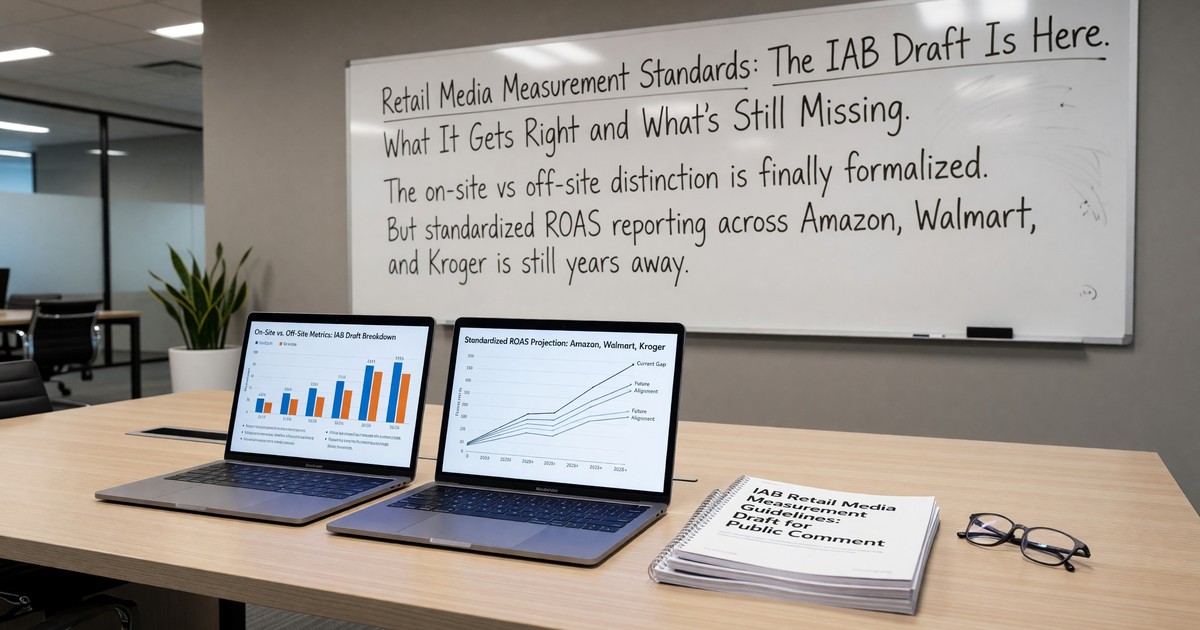
The IAB Tech Lab has published its Retail Media Measurement Guidelines for public comment, and the industry’s response has ranged from cautious optimism to polite skepticism depending on how close you are to the measurement problem the guidelines are trying to solve. The document is real progress. It is also honest enough, if you read it carefully, about what it cannot yet standardize — and that honesty is useful because it tells you what the retail media measurement problem actually is and how far we remain from solving it.
The retail media category has grown dramatically since the last time IAB attempted to develop measurement frameworks for it. Amazon’s advertising business will exceed $40 billion in 2023 annualized run rate. Walmart Connect, Kroger Precision Marketing, Instacart Ads, Target Roundel, Home Depot’s Orange Apron, CVS Media Exchange, and Walgreens Advertising Group have all scaled into meaningful advertising businesses. The category is no longer a niche channel adjacent to e-commerce. It is the fastest-growing segment in digital advertising, and it is eating performance budget that used to go to search, display, and social.
What the IAB Guidelines Actually Define
The IAB Retail Media Measurement Guidelines establish foundational definitions and reporting disclosure requirements across five primary areas.
The on-site versus off-site distinction is the most practically important formalization. On-site retail media is advertising on the retailer’s owned properties — sponsored search placements on Amazon.com, banner placements on Walmart.com, display ads within the Kroger app. Off-site retail media is advertising on publisher inventory outside the retailer’s owned properties, targeted using the retailer’s first-party purchase data — a programmatic display campaign on third-party publishers targeted with Amazon purchase data. These two are fundamentally different products with different inventory, different attribution mechanics, and different competitive sets. The guidelines now formally require network reporting to distinguish which component of spend is on-site versus off-site and to report performance metrics separately for each.
This is significant. Amazon reports total “advertising services” revenue that combines Sponsored Products (on-site) and Amazon DSP (which includes off-site programmatic). Advertisers buying predominantly on-site Sponsored Products alongside some DSP off-site programmatic are getting blended performance metrics that obscure the contribution of each. Requiring separate on-site and off-site reporting is a baseline for any meaningful comparison.
Attribution window standardization is addressed through disclosure rather than mandate. The guidelines require networks to disclose their default attribution windows and to offer consistent reporting across whatever windows they support. Networks that default to 30-day attribution must report what performance looks like at 14-day and 7-day windows so that advertisers can apply their own normalization. This is disclosure-based standardization, not true standardization — but disclosure enables comparison in ways that undisclosed methodology does not.
Measurement methodology definition covers the variables that make ROAS comparisons invalid across networks: same-SKU versus halo attribution (whether the campaign gets credit only for the advertised product or for other basket items), new-versus-returning customer breakout, and view-through versus click-through attribution distinctions. Networks must now disclose which approach they use.
The IAB Tech Lab’s full retail media guidelines document is available for public comment through the fall 2023 comment period. Practitioners with significant retail media investment should submit feedback.
What the Guidelines Get Right
The on-site/off-site separation is the right call, and it is overdue. The bundling of on-site sponsored search performance with off-site programmatic performance in a single ROAS figure has obscured the very different economics, audience dynamics, and competitive contexts of each. On-site retail media is fundamentally a search product competing with Google Shopping for purchase intent. Off-site retail media is fundamentally a programmatic display product competing with open-web targeting for upper-funnel and prospecting budget. Conflating the two produces measurement that is analytically meaningless for channel allocation decisions.
The emphasis on new-versus-returning customer segmentation addresses a measurement problem that is particularly acute in mature retail advertising programs. Brands that have been advertising on Amazon for several years face the challenge of distinguishing genuine customer acquisition — reaching new buyers who would not have purchased without the advertising — from conversion of existing loyal customers who would have purchased anyway. A sponsored search campaign with strong ROAS may be driving almost entirely existing customer repeat purchases, which looks great on a ROAS metric and is nearly worthless as advertising spend. Requiring new-versus-returning segmentation in reporting makes this distinction visible.
The attribution window disclosure requirement is correctly scoped as disclosure rather than mandate. Different product categories have fundamentally different purchase cycles, and a 7-day attribution window makes sense for FMCG repeat purchase categories while a 30-day window is more appropriate for considered purchases. Mandating a single window would disadvantage either fast-cycle or slow-cycle advertisers depending on the choice. Disclosure with consistent cross-window reporting achieves comparability without eliminating appropriate contextual flexibility.
What’s Still Missing
The guidelines do not address incrementality measurement, and this is the most significant gap. ROAS is an attribution metric, not an incrementality metric. It tells you what revenue was associated with ad-exposed buyers; it does not tell you how much of that revenue would have occurred without the advertising. Incrementality testing — holdout methodologies that compare ad-exposed and ad-suppressed populations — is the measurement approach that actually answers the question “did the advertising cause additional sales or did it credit sales that were going to happen anyway?”
Amazon Marketing Cloud supports custom incrementality analysis for sophisticated advertisers, but the guidelines do not create any requirement for networks to report or disclose incrementality-adjusted performance. Until retail media networks are required to either run regular holdout testing or enable advertiser-directed holdout testing within their platforms, ROAS remains a self-reported, attribution-model-dependent metric that does not directly measure advertising effectiveness.
Cross-network standardization — enabling a directly comparable ROAS number across Amazon, Walmart, and Kroger using identical attribution methodology — is explicitly acknowledged in the guidelines as a future aspiration rather than a current achievement. The guidelines create the disclosure infrastructure that would enable advertisers to manually normalize cross-network comparisons, but do not require networks to adopt a common default methodology. True comparability will require either holding group buying pressure or regulatory intervention to mandate common default attribution.
What Advertisers Should Actually Do With the Guidelines
Treat the guidelines as a negotiating framework for your next retail media planning conversations. Request that your network contacts confirm their compliance with the IAB guidelines’ disclosure requirements — specifically, ask for separate on-site and off-site reporting, ask for multi-window attribution reporting (7-day, 14-day, 30-day), and ask for new-versus-returning customer breakouts in their performance reports.
For networks that cannot provide these breakouts, the appropriate response is to discount the reported ROAS when making allocation decisions — not to refuse to buy, but to apply a methodological uncertainty premium that reduces the weight you give to reported figures in budget decisions.
Build your own cross-network normalization model. Take the disclosed attribution methodologies from each of your retail media partners, apply consistent assumptions about window length and attribution scope, and construct a normalized ROAS comparison that is methodologically consistent. This is manual analytical work that should become part of quarterly performance reviews until the industry develops more automated standardization tools.
FAQ
What is the IAB Retail Media Measurement Guidelines and who developed it? The IAB Tech Lab Retail Media Measurement Guidelines is a standards document developed by the IAB Tech Lab’s Retail Media Standards Working Group, which includes major retail media networks, advertisers, and measurement vendors. The guidelines establish common definitions, disclosure requirements, and reporting frameworks for retail media advertising measurement. They are guidance documents rather than legally enforceable standards.
What is the difference between on-site and off-site retail media? On-site retail media is advertising on the retailer’s owned properties — sponsored search placements, display ads, and featured products within the retailer’s website and app. Off-site retail media is programmatic advertising on third-party publisher inventory targeted using the retailer’s first-party purchase data. The IAB guidelines now require networks to report these as separate performance line items.
Why does attribution window length matter so much for retail media ROAS? A longer attribution window captures more conversions in the measurement period and produces a higher reported ROAS for the same campaign performance. Amazon’s default 14-day attribution for Sponsored Brands versus a competitor’s 30-day default means the competitor’s reported ROAS will appear higher for any category with meaningful delayed conversion — not because it performs better, but because it counts purchases over a longer period.
What is incrementality and why don’t the IAB guidelines require it? Incrementality measures how much sales lift a campaign generates beyond what would have occurred without advertising — the true causal advertising effect. The IAB guidelines focus on attribution-based measurement rather than incrementality because requiring holdout testing infrastructure is technically complex and commercially sensitive for networks whose reported ROAS numbers underpin their pricing. Incrementality testing remains the advertiser’s responsibility to implement, not the network’s obligation to provide.
Further Reading from Authoritative Sources
- IAB Tech Lab Retail Media Measurement Guidelines — The IAB Tech Lab’s Retail Media Measurement Guidelines are the direct subject of this article.
- eMarketer retail media spending forecasts and market analysis — eMarketer is the primary market research source for US retail media spending estimates referenced throughout the article.