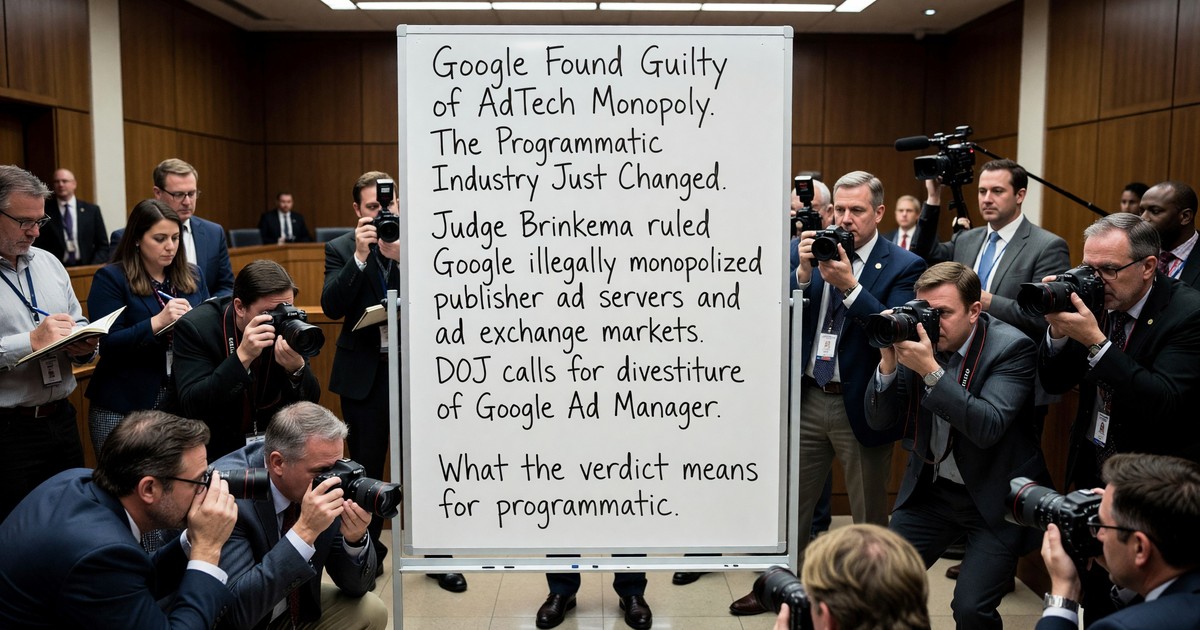
Judge Leonie Brinkema of the Eastern District of Virginia ruled today that Google illegally monopolized the publisher ad server market and the open web ad exchange market. The ruling in United States v. Google LLC — the DOJ’s adtech antitrust case — is the most consequential legal finding in digital advertising’s 25-year history.
The ruling is definitive and specific. Google used its dominant publisher ad server (DFP/Google Ad Manager) and its ad exchange (AdX) together to foreclose competition in ways that illegally maintained monopoly power. The DOJ is calling for structural remedies, including the forced divestiture of Google Ad Manager — which encompasses both AdX (the exchange) and DFP (the publisher ad server).
The programmatic industry is not going back to what it was this morning.
What the Court Found
Judge Brinkema’s ruling covers two liability counts that the DOJ successfully proved.
Publisher Ad Server Monopolization: Google is found to have used its dominant position in publisher ad servers to illegally maintain monopoly power by tying DFP functionality to AdX access in ways that made it economically impractical for publishers to route significant inventory away from Google’s exchange. The court found that Google’s practices — including the conduct described in internal documents as Project Jedi and related reserve price optimization mechanics — constituted exclusionary conduct that harmed competition.
Ad Exchange Monopolization: Google’s AdX is found to have maintained its dominant position through anticompetitive practices rather than superior product merit alone. The specific conduct — last look advantages derived from DFP’s position as publisher ad server, and the header bidding throttling practices — is found to constitute illegal exclusionary conduct under Section 2 of the Sherman Act.
The court did not find in the DOJ’s favor on all counts. The advertiser-side monopolization claims were dismissed or found not proven, consistent with pre-verdict analysis that the publisher market evidence was substantially stronger than the advertiser market evidence.
The DOJ’s Divestiture Call
The Department of Justice is calling for structural remedies, specifically the divestiture of Google Ad Manager. This means requiring Google to sell its publisher ad server (DFP) and ad exchange (AdX) as standalone businesses, separating them from Google’s other advertising products.
The DOJ’s remedy brief argues that behavioral remedies — rules prohibiting specific conduct — are insufficient because Google has shown through years of documented behavior that it will continue to find ways to use its integrated stack to advantage its own products. Structural separation, they argue, is the only remedy that changes the underlying incentive structure.
Google has announced it will appeal. The company’s statement characterized the ruling as incorrect and committed to challenging it through the appeals process. Appeals in federal antitrust cases can take years, and structural remedies are typically stayed during appeal.
The practical timeline: the remedy proceedings begin now. Google’s appeal will run in parallel. A stayed divestiture order — one that doesn’t take effect pending appeal — means Google continues operating the integrated stack while the legal process resolves. The realistic timeline for actual divestiture, if it survives appeal, is years from today.
What Independent SSPs Stand to Gain
The verdict’s most immediate commercial impact will be on independent SSPs — Magnite, PubMatic, Index Exchange, and Xandr — whose competitive landscape is about to change materially even before any structural remedy takes effect.
AdX’s dominant market position has been substantially a function of its integrated access to Google Ads and DV360 demand. Publishers routed a disproportionate share of inventory through AdX not just because of auction mechanics (which the court found to be anticompetitively managed) but because AdX was the most reliable path to Google’s advertiser demand pool — the largest single source of programmatic buying.
A standalone AdX that must compete for Google advertiser demand on equal footing with Magnite and PubMatic is a fundamentally different competitive animal. Independent SSPs that have been building publisher relationships, demand integrations, and technology infrastructure under an assumption of permanent Google structural advantage are now operating in an environment where that advantage is under court-ordered dismantlement.
The verdict doesn’t require publishers to immediately route inventory differently. But it changes the negotiating context for every publisher conversation with every SSP — and it changes the investment thesis for independent SSPs that have been competing at a structural disadvantage.
What Publishers Should Do Now
Publishers don’t need to wait for the remedy proceedings to take action. The verdict provides a clear strategic signal that the open exchange market is going to change, and the publishers best positioned to benefit will be those who have maintained or rebuilt diversified monetization infrastructure.
Audit DFP dependency: How much of your revenue requires DFP to be fully integrated with AdX? Understanding this number gives publishers a clearer view of both their current dependency and their potential optionality.
Evaluate alternative ad server options: The verdict makes this conversation easier to have internally. Alternative ad server providers — Prebid.org’s server product, Kevel, Freestar’s managed options — have improved significantly. Understanding the switching cost is valuable business knowledge regardless of whether a publisher intends to switch immediately.
Build programmatic diversification: Publishers that have already reduced their AdX reliance — through direct-sold campaigns, alternative SSP partnerships, and auction diversity — are better positioned regardless of what the remedies timeline looks like.
What Buyers Using DV360 Should Consider
For programmatic buyers running campaigns through DV360, the verdict creates a legitimate question about infrastructure concentration.
DV360’s core value proposition has been its integration with Google’s publisher supply — particularly the premium access to AdX inventory and the seamless connection between Google’s advertiser data and Google’s publisher infrastructure. A remedy that separates AdX from DFP doesn’t automatically change DV360, but it changes the supply access dynamics that gave DV360 structural advantages.
Independent DSPs — The Trade Desk, Xandr/Microsoft, Basis — operate without the integrated supply advantages that DV360 benefits from. In a structurally separated market, where AdX and DFP are standalone entities competing independently, the DSP selection criteria shift toward transparency, control, and reach rather than supply integration.
The Trade Desk’s years of investments in UID2, OpenPath publisher integrations, and Ventura CTV infrastructure have been building toward exactly this scenario — a programmatic market where supply-side integration advantages from a single vertically integrated player are reduced.
FAQ
Q: What exactly is being divested — AdX, DFP, or both, and are they separate products or one? Google Ad Manager is the commercial product that combines DFP (the publisher ad server, or “DoubleClick for Publishers”) and AdX (the ad exchange, or “DoubleClick Ad Exchange”) into a unified platform. The DOJ’s divestiture call targets Google Ad Manager as an integrated unit — separating the combined product from Google’s other advertising businesses. Whether it’s sold as one entity or split further into separate ad server and exchange companies would be determined in remedy proceedings.
Q: How long will Google’s appeal take, and what happens to the market in the meantime? Federal antitrust appeals in the Fourth Circuit can take two to four years, with potential Supreme Court petition extending the timeline further. During appeal, structural remedies are typically stayed — meaning Google continues operating the integrated product. The market will operate largely as today for the immediate future, but competitive behavior, investment decisions, and publisher strategy will shift based on the verdict’s direction of travel.
Q: Does this verdict affect the separate Google Search antitrust case remedy proceedings? The cases are legally separate. The search case remedy proceedings (in Judge Mehta’s court) and the adtech case remedy proceedings (in Judge Brinkema’s court) run independently. However, the search case verdict finding Google a monopolist in search provides precedent context, and the DOJ may use a favorable adtech remedy ruling to inform aggressive remedy positions in the search case.
Q: Which ad tech companies are most likely to benefit from AdX/DFP divestiture if it happens? Publishers gain the most from DFP divestiture — genuine ad server freedom is their direct benefit. Independent SSPs (Magnite, PubMatic, Index Exchange) benefit from AdX operating without integrated Google demand supply advantages. The Trade Desk and Xandr benefit from buyers’ incentive to diversify away from DV360 as the DSP integrated with a structurally changed supply stack.
Further Reading from Authoritative Sources
- DOJ US v. Google adtech monopoly case verdict and remedy filing — The DOJ’s official case documentation is the primary legal source for the verdict and remedy positions described in this article.
- Prebid open-source ad server capabilities for publishers — Prebid.org is the primary open-source ad technology organization and the specific alternative publisher ad server infrastructure mentioned by name in the article as a DFP alternative.