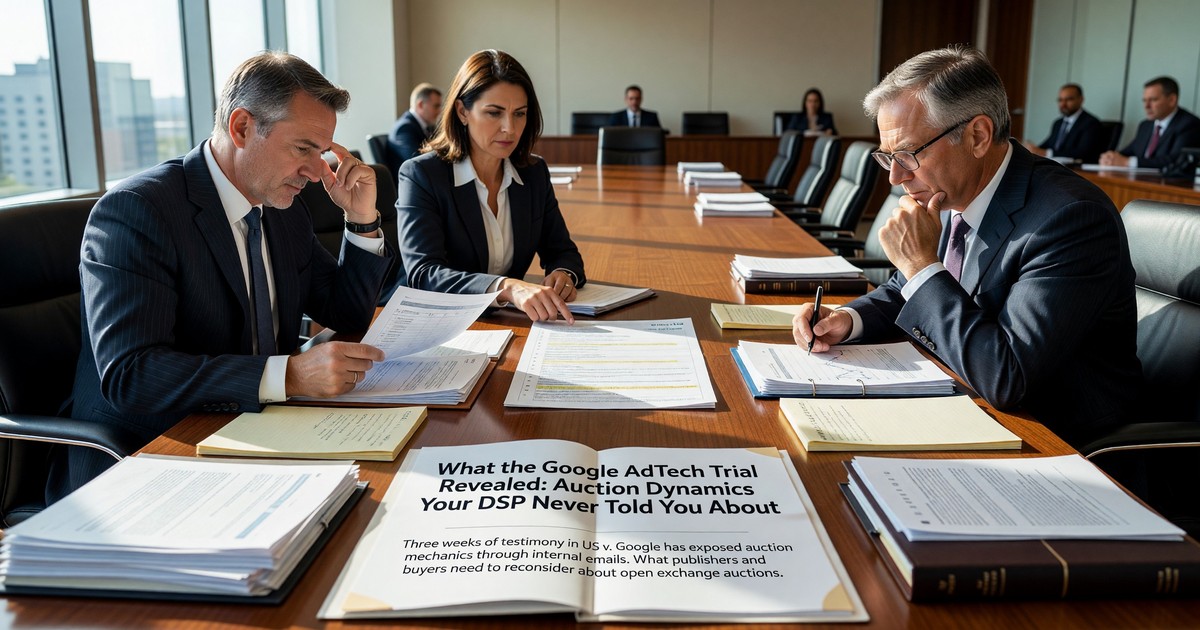
Three weeks into the US v. Google adtech trial, the testimony has been more revealing than most industry observers expected. Internal emails, product documentation, and executive testimony have put on record specific auction practices that, while long suspected in parts of the ad tech industry, have now been described under oath with supporting documentation.
The picture that emerges from the first three weeks of testimony is not of a company that broke rules everyone agreed on — it’s of a company that wrote rules for systems it controlled, in ways that systematically benefited its own products. That’s the conduct at the heart of antitrust law, and it’s what Judge Leonie Brinkema is now evaluating.
The Jedi Blue Emails and What They Actually Show
The most discussed documents from the trial’s first weeks are the internal emails describing Project Jedi Blue — the name given to Google’s last look mechanism in the context of Facebook’s header bidding activity. The DOJ’s version of these documents portrays a deliberate system where Google’s AdX could access competing bids through DFP’s position as the publisher ad server, then submit a matching or beating bid from Google Ads.
Testimony from former Google product managers has attempted to reframe Jedi Blue as a technical optimization process rather than anticompetitive surveillance of competing bids. The distinction matters legally but the operational effect is what publishers and buyers should focus on: any system where one participant in an auction can see competing bids before submitting their own is a structurally compromised auction.
For publishers who ran DFP with header bidding during the period in question, the implication is that their theoretical yield optimization — routing inventory to the highest bidder through header bidding — was operating in an environment where one bidder had information advantages the others didn’t. The clearing prices publishers received were determined by a mechanism that was systematically different from what they understood.
Reserve Price Optimization: The Feature Nobody Talked About
Separate from Jedi Blue, trial testimony has introduced detailed evidence about Google’s reserve price optimization — a feature in Google Ad Manager that dynamically set floor prices in publisher auctions based on algorithms Google controlled.
Reserve price optimization is disclosed Google functionality. But testimony has described how Google’s RPO interacted with AdX’s own auction mechanics in ways that benefited Google Ads buyers relative to non-Google DSPs submitting bids through header bidding.
The allegation, supported by internal analysis presented during testimony, is that RPO floor prices were calibrated in ways that made AdX’s clearing prices less competitive relative to header bidding bids in some scenarios — effectively suppressing the price difference between AdX and header bidding that would have driven publishers toward third-party exchanges. This is distinct from but related to the Poirot throttling allegations.
For programmatic buyers, this matters because it describes an auction environment where the yield signals publishers relied on to make inventory routing decisions were influenced by the same party operating one of the competing exchanges. The information asymmetry ran both ways.
What Publishers Actually Experienced
The most credible testimony has come from publishers describing their operational experience — and it aligns with what many large publishers have said privately for years.
Multiple publisher witnesses have described a DFP ecosystem where switching ad servers was functionally impractical, not because of explicit contractual lock-in but because DFP’s integration with Google demand (specifically Google Ads, which represents the largest source of programmatic advertiser spend) was tight enough that migrating away from DFP risked meaningful revenue loss from losing fill rate from Google Ads buyers.
This is the tying allegation in operational terms. Publishers weren’t required by contract to use DFP alongside AdX. They used DFP because the revenue consequences of not using DFP were severe enough to make alternatives impractical. The question for the court is whether that dynamic reflects superior product quality — Google’s defense — or anticompetitive bundling that exploited market power in one product to foreclose competition in another.
The DOJ’s proposed findings of fact document specific publisher testimony about the switching costs and revenue consequences they experienced. These aren’t theoretical — they’re business decisions made by real publishers with financial data behind them.
What Buyers Should Reconsider About Open Exchange
For programmatic buyers, the trial’s most practically relevant revelations concern what open exchange auctions actually were during the period in question.
The theoretical premise of programmatic buying is that auctions are fair: multiple DSPs submit bids, the highest bid wins, prices reflect competitive market dynamics. The trial record suggests that premise was compromised in the period it describes.
If AdX had last look on header bidding bids, buyers on non-Google DSPs were operating in an auction where their bids could be undercut by a party with prior information. If Google’s reserve price optimization was calibrated to serve AdX’s competitive position, floor prices in publisher auctions were not simply yield optimization — they were a Google product feature with competitive implications.
The implications for current buyers: audit what percentage of programmatic spend flows through AdX versus header bidding paths, understand whether the DSPs you use have full transparency into the clearing price mechanics of exchanges you buy through, and evaluate whether open exchange efficiency assumptions in your media planning models were based on an accurate picture of auction dynamics.
The Competitive Landscape for Independent SSPs
Every week of trial testimony is also, in effect, a marketing event for Google’s programmatic competitors. Magnite, PubMatic, Index Exchange, and Xandr are watching the trial with a direct business interest: if the court finds Google’s conduct unlawful and orders remedies, the competitive dynamics of the SSP market change materially.
Independent SSPs have spent a decade competing against an AdX that, the DOJ alleges, had structural advantages they couldn’t match — not because of better technology but because of bundled access to the largest pool of advertiser demand in programmatic. A finding in the DOJ’s favor, followed by remedies that change the AdX/DFP bundling arrangement, would be the single largest competitive opportunity independent SSPs have seen in their existence.
Xandr (Microsoft) is in a particularly interesting position. Microsoft is a competitor to Google across multiple product lines, has a stake in programmatic through Xandr’s exchange and DSP, and is watching the trial carefully. A structurally weakened AdX is an opening Microsoft would likely move aggressively to capture.
The Timeline From Here
Trial testimony is expected to continue through October. Closing arguments will follow, and Judge Brinkema’s ruling is likely months after that — well into 2025. Any remedy proceedings, should liability be found, would begin after the verdict and could extend the timeline significantly further.
What the trial has already accomplished, regardless of outcome, is creating a comprehensive documentary record of how programmatic advertising’s core infrastructure actually operated. That record — the emails, the testimony, the product documentation — will inform publisher and buyer strategy for years regardless of what the court ultimately decides.
FAQ
Q: What is “last look” in auction terminology and why is it considered anticompetitive? Last look refers to a mechanism where one bidder in an auction can see the current highest bid before submitting their own. In a fair auction, all bidders submit simultaneously without knowledge of competing bids. A last look advantage allows the beneficiary to bid just above the current winner rather than submitting their true maximum value — which suppresses competitive bidding, reduces clearing prices, and disadvantages bidders without the same informational access.
Q: How does Project Poirot relate to Project Jedi Blue — are these the same thing? They’re distinct practices. Project Jedi Blue concerned Google Ads receiving last look advantages on publisher auctions run through DFP. Project Poirot (also called “Bell”) allegedly involved Google Ads reducing its bids on non-Google exchanges (header bidding paths) relative to AdX, effectively pricing down non-Google exchange inventory to protect AdX’s market share. One is about informational advantage in specific auctions; the other is about systematic bid suppression across competing exchanges.
Q: If the court finds Google liable, how long would it take for programmatic market structure to change? Realistically, four to seven years from a liability finding to material market change. The process involves: liability ruling, remedy proceedings (which are separate), potential appeals to the Fourth Circuit, and then compliance implementation. The DOJ search case from 2023 is still in remedy proceedings. Publishers and buyers should plan for the current market structure to persist for the medium term.
Q: Should publishers be exploring alternative ad servers given the trial revelations? Yes, and the trial has accelerated interest in alternatives. Prebid.org’s ad server product, Kevel (formerly Adzerk), and Freestar’s managed publisher solutions are all seeing increased publisher interest. The practical challenge is that alternative ad servers need to demonstrate comparable Google Ads fill rates before publishers can justify the migration cost — which is exactly the dynamic the DOJ is arguing constitutes anticompetitive lock-in.