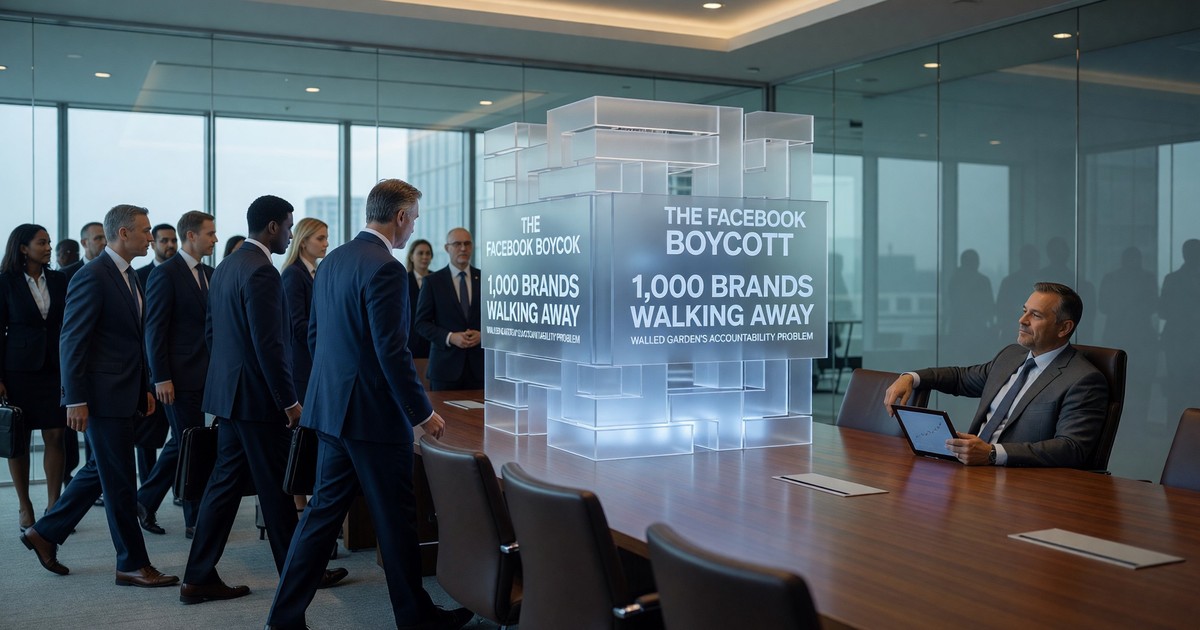
More than 1,000 brands have now joined the #StopHateForProfit campaign, pausing advertising on Facebook for the month of July. The campaign — organized by a coalition of civil rights organizations including the NAACP, Anti-Defamation League, and Color of Change — began in late June following Facebook’s refusal to remove or label content from political figures that the organizations characterized as inciting violence and spreading electoral disinformation.
The brand roster spans the Fortune 500: Unilever, Coca-Cola, Verizon, Honda, Patagonia, Hershey, Ford, Levi’s. By any measure of campaign volume and brand reputation, it is the most significant advertiser action against a major digital platform in history. The question that matters commercially is not whether the boycott is principled — it clearly is — but whether it will change anything. And the structural analysis of how Facebook’s advertising business works suggests the answer is: probably not much.
Understanding why requires understanding the accountability gap that walled garden self-serve advertising creates — and what advertisers who want more accountability should actually be demanding.
The Self-Serve Insulation Effect
Facebook’s advertising revenue is approximately $70 billion annually. The brands participating in the boycott — even a thousand of them — represent a small fraction of that total. This is not a cynical observation. It is a structural fact about how Facebook’s revenue is distributed.
The vast majority of Facebook’s advertising revenue comes from small and medium-sized businesses: the local restaurant, the DTC clothing brand, the mobile app developer buying installs, the Shopify merchant running conversion campaigns. These advertisers have not joined the boycott. They are not organized. They are buying through self-serve interfaces that insulate Facebook from reputational pressure because there is no account manager, no relationship, and no single point of negotiation.
Facebook’s own revenue disclosures confirm that no single advertiser represents more than 1 percent of revenue. The boycotting brands, despite being some of the largest in the world, are collectively a fraction of even that single-percent threshold. When Mark Zuckerberg said in an internal call in late June that the company did not need large advertisers to succeed, he was stating a business reality, not making a negotiating posture.
What the CCPA Enforcement Start Means
July 1, 2020 was also the date California Attorney General Xavier Becerra announced the California Consumer Privacy Act became enforceable. CCPA enforcement — which includes the right to cure period for businesses not in compliance and the AG’s ability to bring actions for violations — is now active.
For Facebook, CCPA enforcement adds a second front to its current crisis. Facebook’s advertising data practices — the cross-site tracking, the custom audience matching, the data-sharing with advertisers — are precisely the practices that CCPA’s right to opt out of sale, right to know, and right to delete provisions address. CCPA does not require opt-in consent the way GDPR does, but it gives California consumers meaningful rights to limit Facebook’s use of their data for advertising purposes.
The question is enforcement scale. The California AG’s office has limited resources relative to the scope of CCPA’s application, and early enforcement is likely to focus on the most egregious violations. But CCPA enforcement creates regulatory risk for Facebook’s data practices that is independent of the advertiser boycott — and the combination of regulatory scrutiny and brand pressure is more consequential than either individually.
The Dual Crisis: Content Policy and Data Practices
What makes this moment structurally different from Facebook’s previous controversies is the simultaneity of the two pressures. The content policy crisis — which is the boycott’s explicit focus — is about what Facebook permits on its platform. The data privacy crisis — which CCPA enforcement has now activated — is about how Facebook monetizes the information its users generate. Both crises ultimately trace back to the same fundamental question: to whom is Facebook accountable for the harms its business model creates?
The answer, structurally, is “primarily to its shareholders and its self-serve advertiser base.” The brands boycotting Facebook have genuine moral standing but limited commercial leverage. Regulators have commercial leverage but historically limited will to exercise it against major tech companies. Users have complaints but do not have enforceable rights over the platform’s content decisions at all.
This accountability gap is the core problem. The walled garden model — where Facebook controls ad serving, attribution, and audience data, and where the platforms are also publishers, measurement providers, and adjudicators of their own performance claims — creates an environment where external pressure has limited purchase.
What Advertisers Should Actually Demand
Brands participating in the boycott have articulated a set of demands, including independent content moderation audits, changes to algorithmic amplification of harmful content, and a stop-hate safety review process. These are legitimate demands. But for advertisers who want the Facebook relationship to be more structurally accountable — not just in this moment of boycott but as an ongoing practice — the more powerful demands are about data and measurement.
Specifically, advertisers should be demanding:
Independent third-party measurement. Facebook’s self-reported advertising metrics — reach, frequency, conversions, video completion rates — have been the subject of multiple lawsuits alleging inflation and inaccuracy. Advertisers should require that campaign performance data be independently validated against off-platform metrics, the same way TV ratings are provided by Nielsen rather than by the networks.
Audience composition verification. Facebook’s demographic targeting is self-declared and platform-reported. Independent verification that campaigns are reaching the audiences they claim — that your automotive campaign is actually reaching in-market car buyers and not proxies — would materially change the value proposition.
Data export and portability. The information Facebook collects about how its users interact with advertiser content is largely locked in Facebook’s systems. Advertisers who want to understand their audiences beyond what Facebook’s reporting UI provides have limited options. Demanding data portability is a structural accountability claim, not just a boycott demand.
The #StopHateForProfit boycott is a moral stand and it deserves credit for forcing a public conversation about platform accountability. Its commercial impact on Facebook will likely be modest. The more lasting impact may be in establishing that major advertisers are willing to organize around accountability demands — and in creating a template for what structural accountability from walled gardens should actually look like.
FAQ
Will the Facebook boycott actually change how Facebook moderates content? Based on available evidence, the commercial impact of the boycott is unlikely to force a fundamental content policy change. Facebook’s revenue is primarily driven by small and medium-sized businesses, not large brand advertisers, and no single large advertiser represents more than 1 percent of Facebook’s revenue. The more likely mechanism for change is regulatory pressure — the FTC’s ongoing antitrust investigation and Congressional scrutiny are structurally more consequential than advertiser pressure. However, the boycott creates reputational pressure that may influence Facebook’s response to regulatory demands.
Should we pull spend from Facebook permanently or just for July? That is a brand-specific decision that depends on your advertising objectives and your assessment of the relationship. For performance-focused advertisers, the practical question is whether the conversions and audience access Facebook provides are available elsewhere at comparable efficiency. For many DTC and mobile app advertisers, the answer is no. For upper-funnel brand advertisers with more flexibility in channel allocation, pausing spend to evaluate alternatives is more operationally feasible. There is no universal right answer.
How does CCPA affect our Facebook advertising data practices? CCPA gives California residents the right to opt out of the sale of their personal information and the right to request deletion of data. If your organization uses Facebook’s custom audience matching to target California residents, you should consult with legal counsel about whether that constitutes a data sale under CCPA and what your disclosure and opt-out obligations are. Facebook’s CCPA data subject request process is available, but coordinating it with your own CCPA compliance program requires internal work.
What data controls should we be negotiating with Facebook as part of a renewed advertiser relationship? At minimum: independent third-party measurement verification for reach and conversion metrics, clear data processing agreements under CCPA and GDPR, contractual commitments about how custom audience data is used and retained, and access to campaign-level data exports that are not filtered through Facebook’s reporting UI. The extent to which Facebook will negotiate these terms depends on advertiser volume, but raising them formally establishes them as expectations rather than optional asks.
Further Reading from Authoritative Sources
- FTC antitrust investigation into Facebook — The FTC’s formal antitrust proceedings against Facebook are directly referenced in the article’s analysis of regulatory mechanisms for platform accountability.
- Marketing Week analysis of the Facebook advertiser boycott — Marketing Week provides authoritative trade coverage of advertiser-platform relationships and brand marketing strategy.