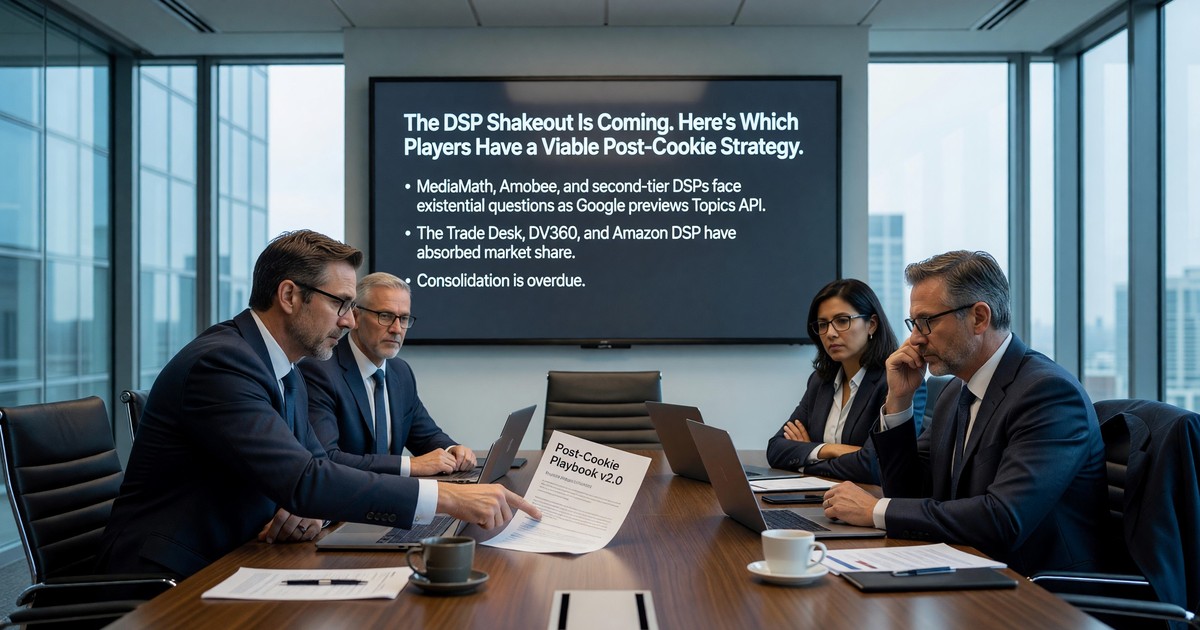
The DSP market that existed in 2018 — twenty or more competing demand-side platforms all operating some version of the same programmatic buying infrastructure with differentiation around audience data, bidding algorithms, and UI — is no longer viable as a market structure in 2022 and beyond. The combination of cookie deprecation, ATT signal loss, and market concentration by the three dominant programmatic buyers has created conditions for a shakeout that the industry has been predicting and delaying for years. The delay is running out.
Google previewed the Topics API this month — the replacement for FLoC — and the preview is instructive not just for what it tells us about Privacy Sandbox’s direction but for what it tells us about which DSPs are positioned to work within the new infrastructure and which are not. The DSPs that have been waiting for cookie replacement clarity to make platform investment decisions are running out of waiting time.
The Market Concentration Reality
The programmatic DSP market has been effectively a three-platform market for several years in terms of volume: Google’s DV360 (and Google Ads for self-serve), The Trade Desk, and Amazon DSP together account for the substantial majority of programmatic display and video investment globally.
Google DV360 operates with structural advantages that no independent DSP can replicate: access to the largest programmatic exchange (Google AdX), integration with the dominant ad server (Google Ad Manager), native integration with Google’s search and YouTube environments, and post-cookie identity through Google Account logged-in users. DV360’s market position is self-reinforcing.
The Trade Desk has established itself as the dominant independent DSP through consistent growth, the Solimar platform investment, UID2 identity infrastructure, and strong CTV capabilities. Its Q3 2021 revenue of $301 million reflects a DSP that is growing into a platform company with broader strategic ambitions than any other independent player.
Amazon DSP has the most defensible first-party data position of the three — Amazon purchase data as a targeting signal is immune to cookie deprecation and ATT in ways that no other DSP’s audience data matches. Its programmatic capabilities are growing rapidly off an already substantial base.
The gap between these three and the next tier is substantial and widening.
The Second-Tier Problem
MediaMath, Amobee (owned by Singtel), Verizon Media’s DSP, and a range of other independent programmatic buying platforms face a question they cannot avoid going into 2022: what is the post-cookie value proposition that justifies the cost structure of operating a full-service DSP?
MediaMath has been in restructuring mode and has pivoted to what it describes as a “supply chain transparency” positioning — focusing on private marketplace, curated supply, and first-party data activation rather than open exchange buying. The pivot is strategically coherent but operationally challenging at a company whose legacy cost structure was built for open exchange volume.
Amobee (Singtel’s adtech subsidiary) has made multiple acquisition moves — buying Turn, Videology, Adconion — and has a video and CTV capability built from Videology’s technology. The parent company’s telecommunications data advantage in Southeast Asia is real but limited in the US market. Singtel has explored potential sale or merger conversations for Amobee repeatedly in recent years.
Sizmek (the former MediaMath ad server asset acquired by Amazon) is now inside Amazon’s infrastructure. Centro’s Basis remains a self-serve programmatic platform but with limited differentiation. StackAdapt and similar emerging platforms are growing in specific niches (native, programmatic audio) but do not compete in the full-service DSP market.
The common problem across the second tier: they all need to build post-cookie identity and measurement infrastructure that Google, The Trade Desk, and Amazon have already built or are well into building. The engineering investment required, at a moment when revenue growth is constrained by market concentration, creates a capital allocation problem that is extremely difficult to solve without a fundamental strategic reorientation.
The Topics API Preview and What It Means
Google previewed the Topics API this week as the replacement for FLoC. The key differences from FLoC: instead of computed browser cohort IDs based on browsing history, Topics assigns users to one of approximately 350 topic categories based on their recent browsing, with only the top five topics from the past three weeks available to any given website. Topics are assigned by Chrome using an on-device model; websites receive topics through a JavaScript API call.
For DSPs evaluating Topics API compatibility, the implication is straightforward: targeting on Google Chrome inventory will, post-cookie, be based on broad topic categories rather than individual behavioral profiles. The 350 topic categories in the current Topics taxonomy are coarser than the behavioral segments that cookie-based campaigns use today. Campaign targeting precision will decline on Topics-based Google inventory.
Google’s Topics API specification is published on GitHub and includes the full topic taxonomy. DSPs that begin integrating Topics API calls in their Chrome-inventory bid handling now will be ahead of those that wait. The integration is not complex — it is an API call that returns the user’s current topics — but the campaign optimization logic built around behavioral segments will need to be rebuilt around topic signals.
What Topics does not address is measurement and attribution. The Privacy Sandbox Measurement API is a separate specification, still in development, that will handle conversion attribution in a privacy-preserving way. DSPs need to track both APIs — Topics for targeting and Measurement API for attribution — as they evolve.
Which Players Have Viable Post-Cookie Strategies
Evaluating DSP viability for the post-cookie environment requires assessing three dimensions: identity infrastructure, measurement capabilities, and inventory access.
The Trade Desk: Strongest post-cookie position among independent DSPs. UID2 integration provides first-party identity infrastructure. CTV inventory relationships provide growth. Solimar’s AI optimization can work with degraded signal. Topics API integration will follow naturally from the existing Privacy Sandbox engagement. Viable.
Google DV360: Structurally advantaged. Google Account identity is cookie-independent. Topics API is a Google product. AdX supply access is unmatched. The CMA investigation creates some uncertainty about what Google will be required to change, but DV360’s core position is defensible. Viable — with regulatory caveats.
Amazon DSP: First-party data advantage is the most durable in the market. Cookie-independent identity for Amazon-authenticated users. Growing off-Amazon programmatic capabilities. Limited in brand-awareness video and premium editorial environments where Amazon has less supply. Viable for commerce-focused buying.
Second-tier DSPs: Viable only with genuine strategic differentiation — a specific inventory type (CTV, audio, DOOH), a specific industry vertical (healthcare, automotive, B2B), or a specific first-party data partnership that creates a defensible niche. Operating as a general-purpose open exchange DSP without a differentiated identity position is not a viable business model post-2023.
FAQ
What is the Topics API and how does it differ from FLoC? The Topics API is Google’s replacement for the FLoC cohort proposal. Where FLoC assigned users to computed cohort IDs based on detailed browsing analysis, Topics assigns users to one of approximately 350 broad topic categories based on their browsing history over the past three weeks. Each site visit can retrieve up to three of the user’s current topics via a JavaScript API call. The key differences: Topics categories are coarser (fewer, broader interest signals), the taxonomy is human-readable rather than computed, and the privacy properties are somewhat better — there is no cohort-based fingerprinting surface in the same way FLoC had. Topics API is still in proposal stage and will go through origin trials before deployment.
Should mid-tier DSPs consider acquisition or merger conversations now? The market structure question — how many viable independent DSPs the post-cookie programmatic market can support — suggests that consolidation is the likely outcome for many second-tier platforms. Whether a specific DSP should pursue acquisition, merger, or strategic partnership depends on its technology assets, client base, and capital position. DSPs with unique technology (BidCore-level infrastructure, proprietary identity graph, specialized inventory access) have acquisition value. DSPs whose primary asset is campaign management UI and open exchange relationships have limited M&A appeal. The window for strategic conversations at favorable valuations is shortening as the market clarity increases.
How should agencies plan DSP investment given the shakeout risk? Agencies managing programmatic investment should have explicit DSP portfolio strategies that account for platform viability risk. For large programmatic budgets, concentration across two or three platforms — including at least one from the dominant-tier — reduces operational risk from platform consolidation or failure. For specialized use cases (CTV, audio, B2B targeting), specialist DSPs may offer superior capabilities today but carry platform risk that warrants monitoring. Build-or-buy a DSP diversification review into your annual planning process.
Does the DSP shakeout affect how we think about in-house programmatic trading? For brands that have built in-house trading desks, the shakeout reinforces the case for platform agnosticism — building campaign expertise and data assets that work across multiple DSPs rather than concentrating on proprietary tools from a single platform. In-house trading desks that have built platform-specific expertise around a second-tier DSP that subsequently faces existential pressure have a real operational risk. The investible in-house expertise is in strategy, audience data, and measurement — not in platform-specific features that change with the next platform generation.
Further Reading from Authoritative Sources
- IAB Tech Lab Privacy Sandbox evaluation and industry guidance — The IAB Tech Lab published comprehensive evaluation of Google’s Privacy Sandbox proposals including FLoC and Topics API, providing the authoritative industry assessment of these technologies’ advertising viability that DSP buyers use to evaluate platform investment.
- Gartner demand-side platform market analysis — Gartner provides authoritative market analysis of adtech platforms including DSPs through its Magic Quadrant and Market Guide publications.