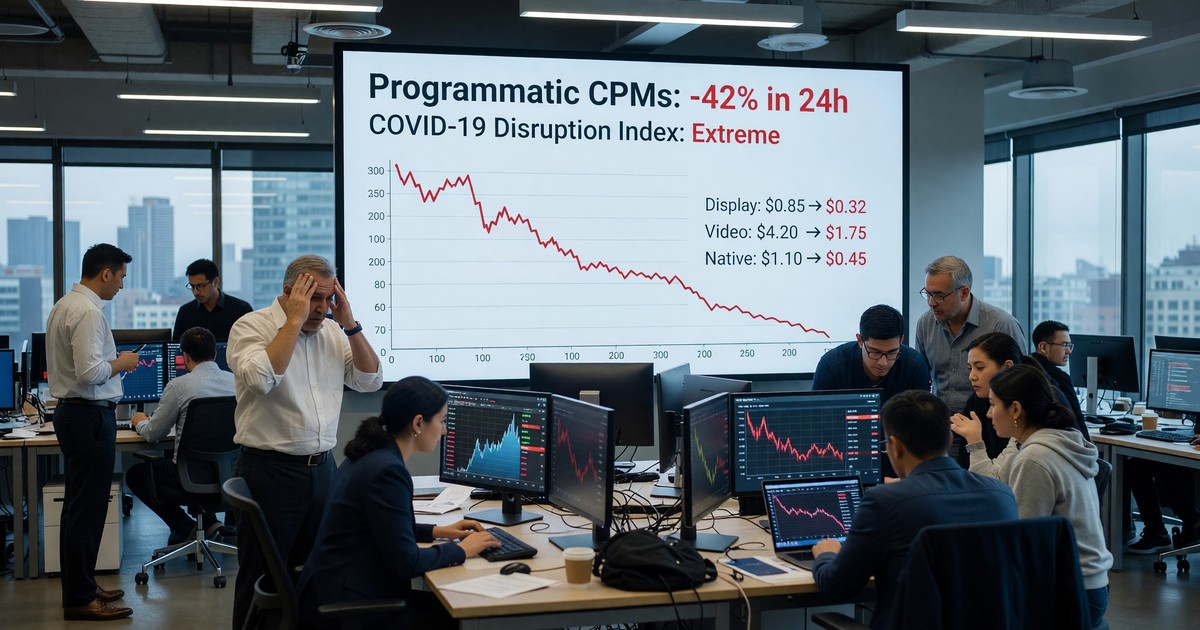
Eight days after the World Health Organization declared COVID-19 a global pandemic, programmatic markets look nothing like they did at the start of this month. Floor prices are being pulled. Travel, hospitality, and retail advertisers are pausing campaigns en masse. Brand safety technology is blocking advertising from appearing adjacent to the most-read news content in years. And in the middle of all of this, a handful of inventory categories are seeing demand — and CPMs — move in the opposite direction.
What is happening in programmatic right now is not a normal cyclical downturn. It is the collision of a demand shock, a supply panic, and a brand safety reflex that, together, are creating some of the most dislocated market conditions the open exchange has seen since programmatic at scale became a reality in 2014.
The CPM Collapse in Open Exchange
The numbers circulating in trade desk conversations and platform dashboards are stark. Display CPMs on open exchange inventory — already under pressure from years of supply-side oversupply — are reportedly down 20 to 50 percent across general news and lifestyle categories in the United States and United Kingdom compared to pre-COVID baselines. In travel and entertainment verticals, some buyers report CPMs down 70 percent or more.
The mechanism is straightforward: advertisers are canceling campaigns or reducing spend faster than any automated floor price mechanism can respond. Publishers who relied on open exchange revenue as a meaningful share of their yield are watching fill rates and CPMs collapse simultaneously. Header bidding auctions that were clearing at $3.50 floor prices last month are clearing at $0.50 or not clearing at all.
This creates a real tension. The supply of available inventory is, if anything, expanding — news publishers are seeing traffic surges as audiences seek coronavirus information. But demand is contracting faster than traffic is growing. The result is an inventory glut priced at distressed levels.
Brand Safety Technology Making Things Worse
The brand safety reflex that kicked in across the industry this week is compounding the CPM collapse in a way that deserves its own attention. IAS, DoubleVerify, and Integral Ad Science — the major brand safety and verification vendors — have seen a surge in requests to add COVID-19 related keywords to block lists. Advertisers understandably do not want their ads appearing next to content about death tolls and overwhelmed hospitals.
The problem is blunt-instrument execution. Keyword blocklists that include terms like “coronavirus,” “COVID,” “pandemic,” “outbreak,” and variations of those terms are now blocking advertising from appearing on the majority of news publisher pages — not because those pages are contextually inappropriate, but because the brand safety technology cannot distinguish between a news page that mentions COVID as an incidental keyword and a news page whose entire subject is pandemic mortality.
The Guardian estimated earlier this week that its COVID-related pages, which include critical public health information and are seeing some of the highest traffic the publication has experienced in years, are generating a fraction of the advertising revenue they would generate under normal circumstances. Comparable reports are coming from The New York Times digital operations, major European news publishers, and dozens of local and regional news organizations.
The irony is profound: at the moment when journalism has its strongest case for social value, the programmatic ecosystem is financially starving it through automated risk-avoidance.
Where Demand Is Actually Surging
Not all inventory categories are in free fall. Connected television — both programmatic and direct-sold — is seeing demand increases as homebound audiences consume more streaming content. Household goods, grocery, and delivery service advertisers are actively bidding for inventory as those categories see consumer demand surge. Health and pharmaceutical categories, where the editorial sensitivity argument is less applicable, are maintaining or increasing spend.
The divergence between collapsing display CPMs and stable or rising CTV CPMs illustrates something the market was already beginning to price before COVID arrived: inventory quality and audience attention are not uniformly distributed, and in a demand shock, the gap between the top of the market and the commoditized long tail widens dramatically.
eMarketer’s most recent CTV projections had US CTV ad spending growing to nearly $9 billion in 2020 before this week. That projection looks questionable in the travel and automotive verticals that have driven CTV growth, but CPM floors in premium CTV environments are holding in ways that open exchange display is not.
The Structural Implications for Publishers
For publishers — and particularly for the news publishers now navigating the collision of peak audience and collapsed revenue — this moment is a live demonstration of the structural fragility of open exchange programmatic revenue. A business model built substantially on open exchange CPMs is a business model that can be destroyed in days by a demand shock and a keyword block list.
The publishers who will come out of this in the strongest position are those who have diversified revenue: direct-sold programmatic deals with private marketplace commitments and guaranteed CPMs, subscription revenue that does not depend on ad impressions, audience extension products that give advertisers access to first-party audience segments across channels. Publishers with long-term preferred deals may be watching their inventory be technically available below floor while their direct partners honor committed CPMs — a concrete illustration of why private marketplace infrastructure matters.
For the long tail of publisher-supported digital journalism — local news sites, vertical trade publications, independent editorial — the picture is bleaker. These organizations typically rely most heavily on open exchange monetization and have the least leverage to negotiate private marketplace alternatives. Some will not survive the coming months regardless of what the programmatic market does.
What Buyers Should Do With Collapsing CPMs
For media buyers watching floor prices disappear, the temptation is to treat this as a buying opportunity — scale up impressions at distressed CPMs and bank the efficiency gains. That approach requires careful navigation.
The context sensitivity issue is real. Advertisers running performance campaigns for categories not directly implicated in the pandemic — direct-to-consumer brands, SaaS products, education — can plausibly increase open exchange buying against distressed CPMs while maintaining brand suitability standards through contextual and semantic targeting rather than keyword blocking. The key is moving from keyword block lists to contextual analysis: block pages that are primarily about crisis and mortality, not pages that mention COVID in passing.
Buyers should also be communicating with publisher partners about the current situation. Publishers who have been investing in direct programmatic relationships deserve to know whether those relationships are being maintained or severed. The PMPs and preferred deals that publishers built during stable conditions were built on the expectation of partnership — treating those commitments as optional in a downturn is a relationship decision with long-term consequences.
Finally, this moment is a useful forcing function for scenario planning. What is your plan for the next 30 days if the situation worsens? What is your plan for the recovery, whenever it comes? The buyers who have answers to those questions now will be better positioned than those who are making reactive decisions week by week.
FAQ
How long are these CPM drops likely to last? It is genuinely impossible to say with certainty given that the pandemic itself is not yet predictable. The closest historical comparison — the post-9/11 advertising contraction — saw digital advertising (then much smaller) decline for approximately two quarters before recovering. Given the global scale of COVID-19 and the forced reduction in spend across travel, hospitality, and retail, a multi-quarter impact seems more likely than a V-shaped recovery. Watch advertiser vertical spend data for early signals.
Should we suspend all keyword blocking related to coronavirus? Not wholesale, but yes, the current keyword block list approach is almost certainly too broad. The recommended approach is to work with your brand safety vendor to implement contextual or semantic-level filtering that identifies page-level context rather than keyword presence. A news page that is primarily about pandemic death statistics is a different contextual environment than a general news page that mentions coronavirus in a sidebar link. The technology to make that distinction exists; the question is whether it has been implemented correctly.
Which DSPs are best positioned to navigate this environment? DSPs with strong CTV inventory access are structurally better positioned than those with primarily display-focused inventory. DSPs with sophisticated brand safety tools that can implement contextual filtering rather than keyword blocking will be more useful to advertisers trying to maintain reach while managing adjacency. Look at what your DSP is doing right now to help you navigate — the ones that are proactively providing guidance and data are the ones worth maintaining relationships with.
How does this affect the upfront and scatter market for the rest of 2020? The programmatic open market crash is bleeding into conversations about scatter market commitments and Q3/Q4 planning. Advertisers in affected verticals are exercising force majeure provisions and cancellation rights in direct deals where they exist. The longer the pandemic disruption continues, the more likely it is that annual planning cycles for 2020 become irrelevant and organizations move to shorter-horizon planning. Expect the upfront as a format to be under particular scrutiny this season.