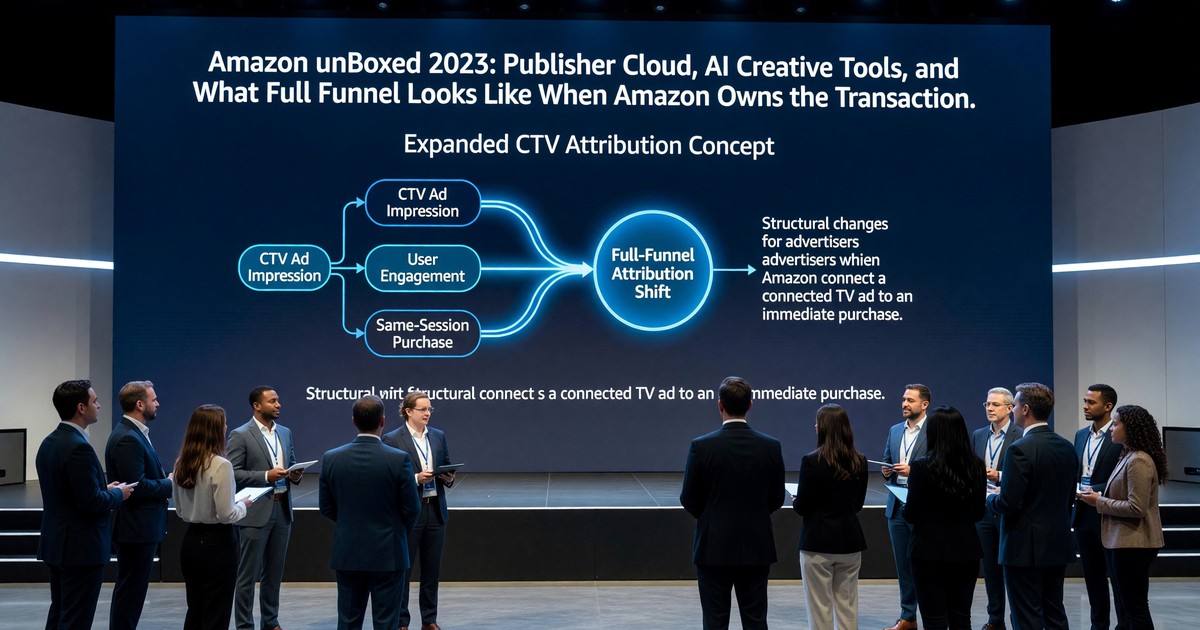
Amazon unBoxed 2023 delivered a product slate that makes clear Amazon’s advertising business is operating at a different architectural level than any competitor. The headline announcement is Amazon Publisher Cloud — a clean room offering that enables publishers to connect their first-party audience data to Amazon’s first-party purchase and media data for audience activation and measurement. But the most strategically significant development from unBoxed is not any single product. It is the emergence of a platform where a CTV advertising impression can be directly and deterministically attributed to a same-session Amazon purchase.
That capability — which Amazon is the only platform in the world currently positioned to offer at scale — changes what “full funnel” means in a fundamental way. Every other advertising platform can show you that an ad impression preceded a purchase. Amazon can show you that a Prime Video ad impression preceded a purchase completion on Amazon.com in the same session, by the same authenticated user, with deterministic identity matching. The attribution is not modeled. It is observed.
Amazon Publisher Cloud: The Clean Room Opens to Publishers
Amazon Marketing Cloud, launched in 2021 and refined through 2022-2023, gave Amazon’s direct advertising customers — brands buying on Amazon DSP — the ability to run custom analytics against Amazon’s first-party event data. Publisher Cloud extends the clean room model to publishers, enabling them to match their first-party audience data against Amazon’s purchase signals for audience building and activation.
The specific use case: a premium publisher with a first-party authenticated audience can connect their reader data to Amazon Publisher Cloud, run overlap analysis against Amazon’s purchase history data, and build enriched audience segments that identify their readers who are in-market for specific product categories. These segments can then be activated in programmatic deal structures with Amazon DSP buyers, providing the buyers with audience intelligence that combines the publisher’s content context with Amazon’s purchase intent signal.
Amazon’s unBoxed 2023 press release describes Publisher Cloud as enabling publishers to “combine their first-party signals with Amazon’s shopping and entertainment signals.” The specific data assets Amazon brings to the combination — purchase history, shopping browse behavior, Prime Video viewing, Amazon Music listening — represent the broadest consumer behavioral dataset available to any advertising platform.
The structural advantage for publishers participating in Publisher Cloud is meaningful: access to Amazon’s purchase signal enrichment makes their audiences more targetable and more attributable than what they could offer independently. The structural cost is that participating publishers are contributing to Amazon’s advertising ecosystem and strengthening Amazon’s position as the central data layer in programmatic.
CTV Attribution: The Same-Session Purchase Attribution Capability
Amazon’s CTV advertising has been growing rapidly through Amazon Streaming TV (formerly Amazon OTT), which includes Prime Video placements, IMDb TV content, and third-party streaming app placements through Amazon’s Fire TV platform. The unBoxed 2023 announcements expanded attribution capabilities for Amazon’s CTV placements, and the direction of development is toward the same-session attribution capability that makes Amazon’s CTV fundamentally different from any competitor.
The mechanism: Amazon users who watch Prime Video and shop on Amazon.com are the same authenticated user across both surfaces. When an Amazon DSP ad appears in a Prime Video stream and the same user subsequently visits Amazon.com and makes a purchase, Amazon can connect those events deterministically — not through probabilistic device matching, not through modeled attribution, but through its own first-party user authentication system.
No other streaming platform has this capability at scale because no other streaming platform also operates a major e-commerce platform. Hulu can tell you that a user watched a CTV ad; it cannot tell you deterministically that the same user then purchased a specific product. Netflix can tell you about viewing behavior; it has no purchase transaction data. Disney’s theme park and merchandise data provides some cross-surface insight, but at a scale and commercial depth that does not approach Amazon’s e-commerce transaction volume.
For advertisers selling on Amazon, the implication is significant: CTV advertising that previously required upper-funnel awareness budgets and probabilistic attribution can now be measured with lower-funnel attribution precision. An e-commerce brand running Amazon Streaming TV ads can measure the direct contribution of CTV impressions to Amazon purchases by the same authenticated users, at the individual impression level.
AI Creative Tools: What Amazon Generated for Advertisers at unBoxed
The creative generation announcements at unBoxed 2023 extend the generative AI trend in advertising into Amazon’s specific context. Amazon launched AI-powered image generation capabilities within its advertising console, enabling advertisers to generate contextual lifestyle backgrounds for product images — the AI wraps a product photo in a relevant lifestyle context (a blender shown in a kitchen environment, a camping tent shown in a forest setting) without requiring a separate creative production process.
This is specifically relevant for the long tail of Amazon advertisers who sell on the platform but do not have professional product photography or lifestyle creative. The majority of Amazon’s hundreds of thousands of advertising customers are small-to-mid-size sellers with minimal creative production resources. AI-generated contextual backgrounds meaningfully improve ad creative quality for this cohort without significant cost.
For large-brand advertisers with professional creative, the AI creative tools are less transformative but still operationally useful for creative variant generation and localized campaign asset production. The quality floor Amazon’s AI generation establishes is important for the overall inventory quality signal — better average creative quality across Amazon’s ad ecosystem improves the user experience and, consequently, the advertising value of premium Amazon placements.
What Full-Funnel Looks Like When One Platform Owns the Transaction
The strategic implication of Amazon’s unique position — CTV distribution, programmatic display, search advertising, and transaction completion all within one authenticated ecosystem — is that full-funnel measurement, which every platform has promised and delivered only approximately for a decade, is actually achievable within Amazon’s walled garden.
A brand running Amazon Streaming TV for awareness, Amazon DSP for consideration retargeting, Sponsored Brands for decision-stage search, and Sponsored Products for conversion can now measure the contribution of each stage to actual Amazon purchases with attribution fidelity that genuinely reflects the customer journey rather than approximating it. Amazon Marketing Cloud enables the path-to-purchase analysis that maps CTV impression → DSP impression → sponsored search click → purchase conversion with individual-level deterministic data.
The caveat — and it is an important one — is that this full-funnel visibility exists only for purchases that complete on Amazon. Brands with significant off-Amazon DTC sales, multi-channel retail distribution, or in-store purchase patterns cannot measure the Amazon advertising contribution to those off-Amazon conversions with equivalent precision. Amazon’s full-funnel attribution advantage is complete only when Amazon is also the conversion point.
For brands that sell primarily or exclusively through Amazon, this is a profound measurement advantage. For omnichannel brands, the Amazon channel delivers superior measurement within the Amazon transaction ecosystem while the off-Amazon channels remain subject to the standard probabilistic attribution challenges that affect all digital advertising.
FAQ
What is Amazon Publisher Cloud and how is it different from Amazon Marketing Cloud? Amazon Marketing Cloud (AMC) is designed for brands buying Amazon advertising — it lets advertisers run custom analytics on their campaign data combined with Amazon’s audience signals. Amazon Publisher Cloud is designed for publishers — it lets publishers match their first-party audience data against Amazon’s signals to build enriched audience segments for programmatic deal activation. AMC is a buyer tool; Publisher Cloud is a seller tool.
How does Amazon’s same-session CTV attribution work technically? Amazon authenticates users across Prime Video and Amazon.com through the same account system. When an authenticated user sees a CTV ad in Prime Video and subsequently makes a purchase on Amazon.com, Amazon can match these events to the same authenticated user deterministically — no probabilistic device matching or statistical inference is required. The attribution is based on observed events linked by first-party identity.
Does Amazon Publisher Cloud require publishers to use Amazon DSP? Publisher Cloud is designed to activate publisher audiences through Amazon DSP deal structures, so effective monetization of Publisher Cloud audience segments is tied to Amazon DSP buyer relationships. Publishers can use Publisher Cloud for analytical purposes without committing exclusively to Amazon DSP, but the activation value is primarily realized through Amazon DSP deal activations.
What are the competitive implications of Amazon’s full-funnel attribution for Google and Meta? Google can offer comparable search-to-conversion attribution for Google Shopping and Google Ads, but its CTV attribution through YouTube lacks the same-platform transaction data that Amazon has. Meta’s ATT-impacted attribution does not offer deterministic cross-surface matching for off-platform purchase events. Amazon’s full-funnel advantage is specific to categories where Amazon is a primary transaction channel — consumer packaged goods, electronics, and other Amazon-dominant retail categories.
Further Reading from Authoritative Sources
- IAB Tech Lab clean room interoperability standards — The IAB Tech Lab’s clean room interoperability standards provide the authoritative technical framework for data clean rooms of the type Amazon Publisher Cloud represents.
- IAB CTV advertising measurement and attribution standards — The IAB’s CTV advertising standards are the primary industry reference for CTV measurement methodology and attribution standards.