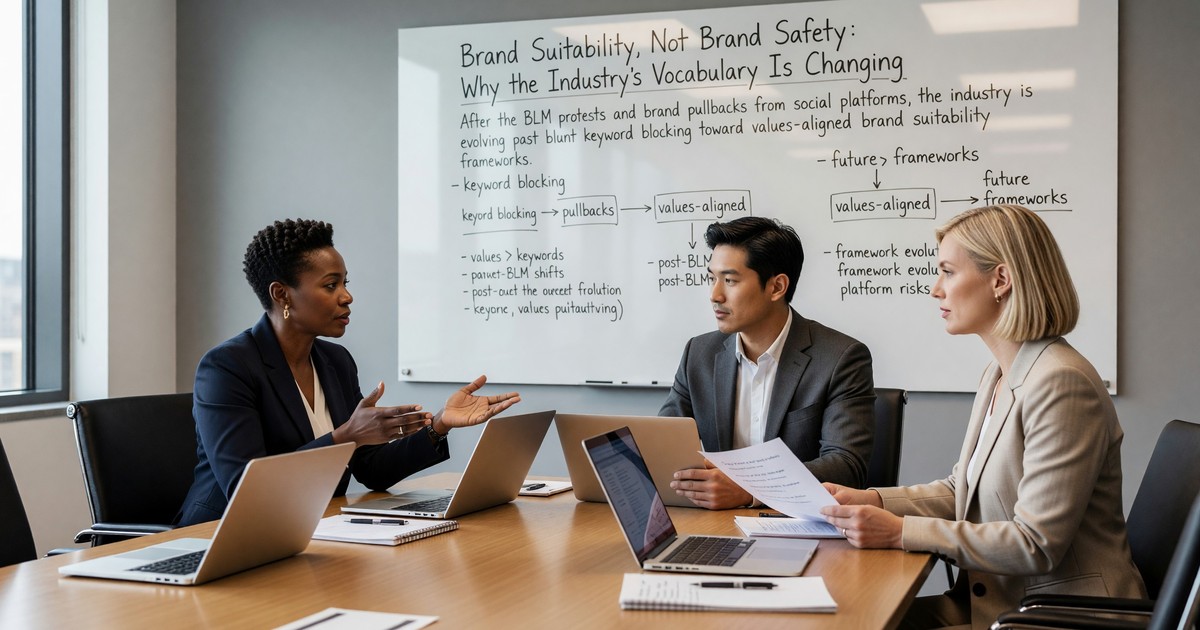
The past four weeks have forced the advertising industry to confront a problem it has been imprecisely managing for years: the difference between content that is generically harmful to any brand and content that conflicts with a specific brand’s values. That distinction — the gap between brand safety and brand suitability — has moved from a niche industry discussion to the center of advertiser decision-making in the space of two news cycles.
The protests following George Floyd’s death in late May triggered a wave of brand responses ranging from genuine solidarity statements to calculated silence. As brands made public commitments to racial justice, media buyers began asking a question the existing brand safety technology stack was not built to answer: how do we ensure our advertising is not appearing adjacent to content that conflicts with the values we just publicly committed to — not just content that is generically dangerous?
That question has no good answer in a keyword-blocking framework. It requires a fundamentally different approach to content classification — one that aligns to what a brand stands for, not just what no brand wants to be near.
What Brand Safety Addressed — and What It Missed
Brand safety as an industry practice was built for a specific problem: preventing advertising from appearing adjacent to clearly objectionable content. Extremist ideology, graphic violence, illegal activity — these categories are problematic for virtually every advertiser, and building technology to identify and block them at scale was a legitimate and necessary investment.
The tools that emerged — primarily keyword-based classification and URL-level blocking — were effective for the core use case. Pages containing words associated with violence or extremism could be identified programmatically and advertising could be suppressed. Brand safety technology scaled. It became a standard campaign requirement. And it was applied increasingly broadly, as the COVID keyword blocking episode in March and April demonstrated, to content that was not actually unsafe for any specific brand.
What brand safety technology was never designed to do is make values-based distinctions. A keyword block list cannot answer the question: is this content appropriate for a brand that has publicly committed to racial equity and that is trying to ensure its advertising investments do not fund media that conflicts with those commitments? That question requires knowing what a brand values, understanding what specific content is actually saying, and making a classification decision that is specific to the brand’s context — not universally applicable across all advertisers.
The IAB Brand Suitability Framework
The IAB’s Brand Suitability Framework, published this month in updated form, attempts to codify the vocabulary shift. The framework distinguishes between:
Brand safety: Content avoidance that applies universally — content that no legitimate brand should advertise against, including content that promotes violence, illegal activity, or terrorism.
Brand suitability: Content that may be appropriate for some brands but not others based on the brand’s specific values, audience, and communication objectives.
The framework introduces a tiered content classification scheme, adapted from the IAB Content Taxonomy, that allows advertisers to configure their suitability preferences at a level of specificity that keyword blocking cannot achieve. Rather than blocking all news related to civil unrest, a brand can specify that it is comfortable advertising adjacent to news coverage of protests and civil rights but not adjacent to content that is framed positively toward violence.
The infrastructure to implement this at scale — across the hundreds of DSPs, SSPs, and publishers that touch programmatic campaigns — does not fully exist yet. But the conceptual framework is a genuine advance over the binary “safe / not safe” model that keyword blocking represents.
GARM and What It’s Trying to Build
The Global Alliance for Responsible Media (GARM), launched by the World Federation of Advertisers in 2019, has accelerated its work this year and is positioning itself as the industry body that will create the consistent brand suitability standards the IAB framework calls for. GARM’s Brand Safety Floor + Suitability Framework defines a “floor” of content categories that all advertisers should avoid universally, and then a suitability spectrum above that floor where brand-specific decisions apply.
GARM’s membership includes major advertisers — Unilever, Procter & Gamble, Mars, Diageo — and the ambition is to create cross-platform, cross-vendor standards that are implemented consistently so that advertisers can configure brand suitability once rather than re-specifying it for each platform and vendor. That ambition is ambitious. Social platforms, programmatic exchanges, content verification vendors, and publishers all have different classification architectures, and aligning them to a single taxonomy is a multi-year project.
What GARM provides in the near term is legitimacy for the vocabulary shift. When major advertisers publicly adopt a brand suitability framework and commit to applying it consistently, it changes the market expectation of what brand safety technology should be able to do. The technology investment follows the commercial demand.
Why Keyword Blocking Fails
The failure modes of keyword blocking extend beyond the COVID episode. The same mechanism that blocks advertising from appearing adjacent to coronavirus content has historically been used to block LGBTQ+ content, blocking advertising from publications and creators whose audiences are actively sought by brands with progressive values. The same mechanism blocks advertising from legitimate reporting on violence even when that reporting is contextually appropriate for public health brands or news organizations. The same mechanism can be configured — intentionally or accidentally — in ways that discriminate against communities by blocking content about their experiences.
Digiday’s research has documented cases where block lists provided by major brand safety vendors contain terms that correlate with race and sexuality in ways that systematically defund content created by and for communities of color and LGBTQ+ audiences. This is not a theoretical harm. It is a documented pattern in which the technology that advertisers use to protect their brands is simultaneously redirecting revenue away from specific editorial communities.
The brand suitability framework, properly implemented, provides a path out of this. Values-aligned content taxonomy allows advertisers to specify positively what they want to be adjacent to — editorial on social justice, community content, civil society journalism — rather than negatively specifying what to avoid. The shift from avoidance to alignment is both ethically and commercially superior.
What a Values-Aligned Content Taxonomy Looks Like
In practice, a values-aligned content taxonomy starts with a brand’s stated commitments and translates them into content classification criteria. A brand that has publicly committed to racial equity and that wants its advertising to reflect that commitment would configure its taxonomy to:
- Include editorial content about racial justice, civil rights, and systemic equity conversations
- Exclude content that frames violence favorably or that promotes white nationalist perspectives
- Be neutral on political news broadly, making adjacency decisions based on content framing rather than topic
This configuration is fundamentally different from adding “Black Lives Matter” and “protest” to a block list — which is what keyword blocking would do. It requires contextual analysis that can interpret content’s framing and perspective, not just its topic. The vendors building this capability include Peer39, Grapeshot/Oracle, and GumGum’s VERITY platform; the specific configurations require brand-side investment in defining what the taxonomy means for each advertiser.
The conversation the industry is having right now — forced by COVID, accelerated by the BLM moment — is ultimately about whether programmatic advertising wants to be a values-neutral pipes-and-pipes infrastructure business or whether it wants to be something that connects brands to audiences in ways that reflect what both the brand and the audience care about. The first option is simpler to build and operate. The second option is what the market is increasingly demanding.
FAQ
What is the difference between brand safety and brand suitability in practical terms? Brand safety covers content that no advertiser should run against — violent extremism, illegal activity, graphic content. It is a universal floor. Brand suitability covers content that is appropriate for some brands but not others, based on each brand’s specific values, audience, and communication goals. A pharmaceutical brand might find health crisis content brand-suitable while a luxury goods brand might not. Implementing brand suitability requires brand-specific configuration, not just applying an industry-standard block list.
How do I configure brand suitability in my current DSP or campaign setup? Most major DSPs support some form of contextual or semantic classification that goes beyond keyword blocking, typically through integrations with IAS, DoubleVerify, Peer39, or Grapeshot. The starting point is requesting a content taxonomy segment build from your verification vendor that reflects your brand’s specific suitability criteria, rather than using default block lists. This is available today but requires active configuration — it does not happen automatically when you set up a campaign.
Is GARM’s framework actually being adopted by publishers and platforms? GARM has signed commitments from major social platforms — Facebook, Twitter, YouTube/Google, TikTok — to implement its brand safety floor standards. Implementation of the full suitability spectrum is less advanced. Publishers have been slower to adopt formal GARM taxonomy mapping across their inventory. In programmatic environments, adoption is patchy — major premium publishers are more likely to have taxonomy-mapped inventory than the open exchange long tail.
Does brand suitability mean I have to review every publisher and page individually? No. The goal of brand suitability infrastructure is to make brand-specific values configurable at scale — so that your DSP or campaign setup applies your taxonomy preferences automatically across all buying, the same way keyword blocking applies automatically today. The difference is that the taxonomy is richer and more precise than a keyword list. The human work is in defining the taxonomy; the execution at scale should be automated.