Amazon unBoxed 2022 is done, and the product announcement that matters most for how the programmatic industry develops over the next three years was not a new ad format, a targeting expansion, or a DSP update. It was the consolidation of Amazon Marketing Cloud as the primary framework through which Amazon wants sophisticated advertisers to think about their investment in Amazon’s ecosystem. AMC is Amazon’s answer to the clean room moment, and it is better-developed and more strategically important than most of the clean room conversations happening elsewhere in the industry.
Amazon Marketing Cloud is a privacy-safe, cloud-based measurement environment that allows advertisers to analyze their own first-party event data alongside Amazon’s advertising exposure data — what Amazon calls signal-on-signal analysis. The core capability: you can run queries that join your CRM data with Amazon’s impression and click data to understand the full customer journey, not just the last-click event that standard Amazon attribution reports.
This is not a trivial capability. For consumer brands that sell on Amazon, the attribution gap between what standard Sponsored Products reporting shows and what actually drove sales has been a persistent frustration. AMC closes that gap by enabling multi-touch path analysis that shows every ad touchpoint in the purchase journey — awareness video on streaming video, consideration via Sponsored Brands, conversion via Sponsored Products — along with the relative contribution of each.
What AMC Enables That Standard Reporting Does Not
Standard Amazon advertising reporting is transactional: it shows clicks, impressions, ACoS (advertising cost of sales), and attributed purchases within defined attribution windows. This is useful for individual campaign management but provides limited insight into cross-campaign path-to-purchase dynamics.
AMC unlocks four categories of analysis that standard reporting cannot provide.
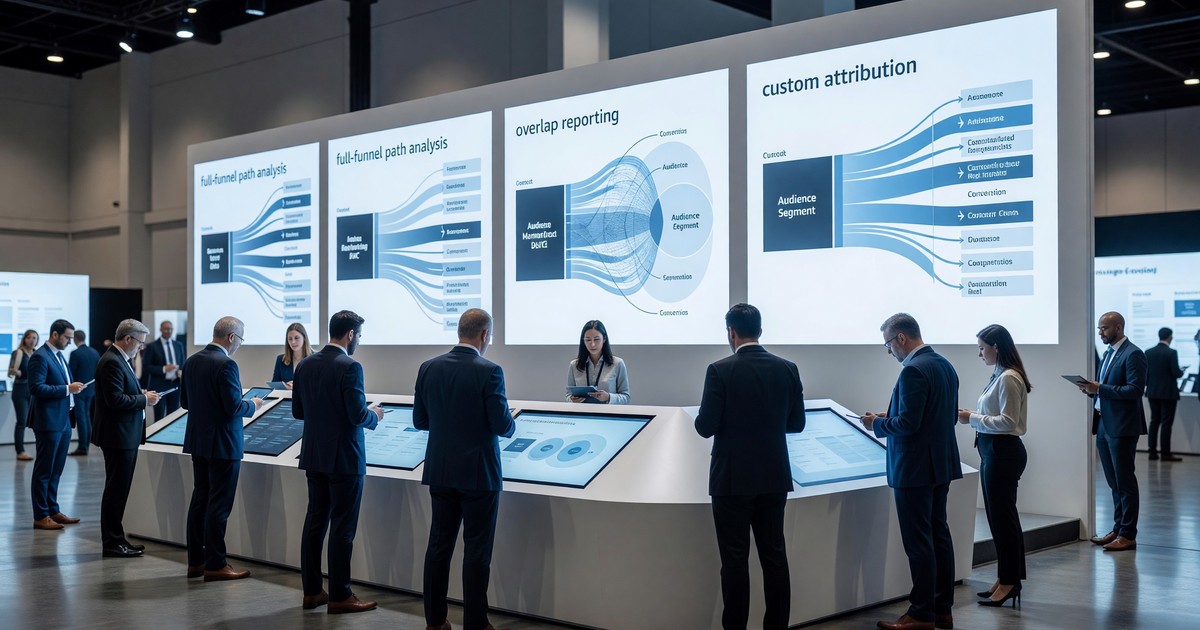
Full-funnel path analysis shows the sequence of ad touchpoints before purchase. For a brand running both upper-funnel Amazon DSP programmatic and lower-funnel Sponsored Products, AMC can reveal whether the DSP impression preceded the sponsored search click for the highest-value customers — and therefore whether upper-funnel investment is accelerating lower-funnel conversion rather than just running in parallel with it.
Audience overlap reporting identifies the intersection between a brand’s first-party CRM segments and Amazon’s audience segments, enabling more precise audience targeting decisions. Which of your high-LTV customers are also heavy Amazon Prime Video viewers? Which have not purchased on Amazon in the past 90 days despite being active on your DTC site? These questions require joining your data with Amazon’s in an environment where raw data never leaves the clean room.
Custom attribution modeling lets advertisers override Amazon’s default last-click (or last-touch-within-window) attribution with their own model. A brand that believes upper-funnel brand advertising deserves more credit than Amazon’s default model assigns can build a custom multi-touch attribution model in AMC and apply it to their campaign portfolio.
New versus returning customer segmentation has become increasingly important as Amazon’s tools have evolved. Regulators and investors both care about new customer acquisition efficiency. AMC lets advertisers measure whether specific campaigns are efficiently reaching new-to-brand customers or primarily re-engaging existing purchasers — a distinction that standard ROAS reporting conflates.
The Hard Requirement: Amazon DSP
Here is the catch that every AMC conversation eventually reaches: the full AMC capability set requires Amazon DSP usage. Amazon Sponsored Ads data (Sponsored Products, Sponsored Brands, Sponsored Display) can be analyzed in AMC on its own, which is valuable. But the cross-channel path analysis — connecting DSP impression exposure to sponsored search conversion — requires Amazon DSP as the programmatic buying vehicle.
Amazon’s AMC documentation is explicit: AMC signal-on-signal queries joining Amazon Streaming TV and Amazon DSP impressions with conversion data require active DSP campaigns. This is not an accidental product design choice. It is a structural tie between Amazon’s premium measurement infrastructure and Amazon’s programmatic buying platform.
For advertisers who have been buying Amazon Sponsored Ads through the retail-oriented console but have not engaged with Amazon DSP for programmatic display and video, AMC’s full capability set represents a meaningful incentive to migrate incremental budget. The measurement story is compelling. The price of the measurement is DSP spend commitment, which typically comes with minimum monthly spend requirements.
Clean Rooms as the Price of Premium Data
AMC fits into a broader pattern in programmatic: access to first-party data that matters — purchase history, authenticated identity, viewing behavior — now requires technical infrastructure investment that creates high barriers to entry. The era of buying behavioral audience data through a standard DSP segment is ending. Premium audience data is increasingly available only through clean room environments that require technical integration and often require spend commitment on the data owner’s buying platform.
LiveRamp’s Safe Haven, InfoSum’s data bunker architecture, and Habu are all building clean room infrastructure for publisher and retailer data collaboration. But none of these has the data asset quality of Amazon’s actual purchase history combined with its streaming media viewership data. The Amazon first-party data asset — what people search for, what they buy, what they watch on Prime Video — is the most commercially relevant behavioral dataset in advertising.
The practical consequence for agency trading desks is that clean room capability is no longer optional for clients with meaningful Amazon investment. Understanding AMC enough to run basic path analysis and audience overlap queries is a baseline competency, not an advanced analytics offering. Agencies that are still treating AMC as exotic infrastructure are behind the curve for CPG and retail clients with material Amazon spend.
Benchmarking the Rest of the Clean Room Market Against AMC
The AMC launch of 2021-2022 has effectively set the functional standard against which every other clean room product will be evaluated. The key dimensions on which other clean rooms compete or fall short:
Data asset quality: AMC’s purchase data and streaming media data are uniquely rich for consumer brand advertising. Publisher clean rooms (Disney’s, NBCUniversal’s, The Trade Desk’s Galileo) have premium content viewership data but lack the transactional purchase signal. Retail media clean rooms for Walmart, Kroger, and Target have purchase data but at smaller scale than Amazon.
Query flexibility: AMC runs on AWS Clean Rooms infrastructure and supports custom SQL queries with significant analytical flexibility. Some clean room implementations offer more constrained query environments that limit the analysis you can run.
Cross-platform integration: AMC is primarily an Amazon-internal tool. Cross-publisher clean room platforms like LiveRamp Safe Haven are designed for multi-publisher collaboration, which requires neutrality that Amazon cannot offer.
The right frame for AMC is not that it replaces multi-publisher clean rooms — it does not — but that it represents the functional standard for what clean room infrastructure should deliver within a first-party data ecosystem. Any publisher or retailer pitching a data clean room to advertisers now has an implicit comparison to AMC’s capability set.
FAQ
What is Amazon Marketing Cloud and who is it for? Amazon Marketing Cloud is a privacy-safe measurement environment that allows advertisers to analyze their first-party data alongside Amazon advertising event data. It is designed for brands with significant Amazon advertising investment who want to understand cross-channel attribution, full-funnel path-to-purchase, and audience overlap beyond what standard Amazon console reporting provides.
Does AMC require Amazon DSP usage? Some AMC capabilities are available with only Sponsored Ads data. Full signal-on-signal analysis joining streaming video or display impression data with conversion events requires active Amazon DSP campaigns. The richest AMC use cases — cross-channel path analysis, reach and frequency optimization across DSP and Sponsored Ads — are only available to advertisers running Amazon DSP.
What are the privacy guardrails in AMC? AMC operates on a clean room model where advertisers cannot access raw Amazon customer data — they can only run aggregated query outputs that meet Amazon’s minimum result size thresholds (preventing identification of individual users). Advertisers can bring their own first-party data into AMC but cannot export Amazon’s data out of the environment.
How does AMC compare to clean rooms from LiveRamp or InfoSum? AMC is purpose-built for Amazon’s ecosystem and provides unmatched access to Amazon’s first-party purchase and media data, but is not designed for cross-publisher collaboration. LiveRamp Safe Haven and InfoSum are designed for multi-publisher and multi-brand data collaboration, offering breadth of integration that AMC does not. They lack access to Amazon’s proprietary purchase data.